We ordered the $20.60 navy heart tee, measured it flat, wore it for five days and washed it twice. The boxy cut tracks AMI's own fit guide closely; the fabric label, split between polyester and cotton, does not.
- Hands-on score
4.0 / 5 4.0 / 5
Editor score 4.0 / 5
- Editor verdict
- The boxy cut matches AMI's own fit language and the navy holds its colour through two washes. The fabric label contradicts itself, and the printed heart needs cold, careful washing. Good at $20.60, once you confirm the blend.
- What works
- Relaxed, boxy shoulder line that follows AMI's published fit guide rather than a slim cut.
- What works
- S to 6XL size run, with navy among six style codes and four colour families.
- What works
- Navy showed no bleeding, no print cracking and no measurable shrinkage over two cold washes.
- Watch-outs
- Polyester is named as the main composition while cotton is named as the fabric — unresolved.
- Watch-outs
- The heart is printed, not embroidered, and will crack if washed warm or tumble dried.
- Watch-outs
- Generous armhole means sizing up buys width at the opening, not useful room.
Buyers who want AMI's relaxed boxy silhouette and a heart graphic at about $20.60, and who will confirm the fabric blend with the seller before ordering.
Skip it if you want verified 100% cotton jersey or a stitched heart, or if you need published per-size garment measurements before buying at the top of the size run.
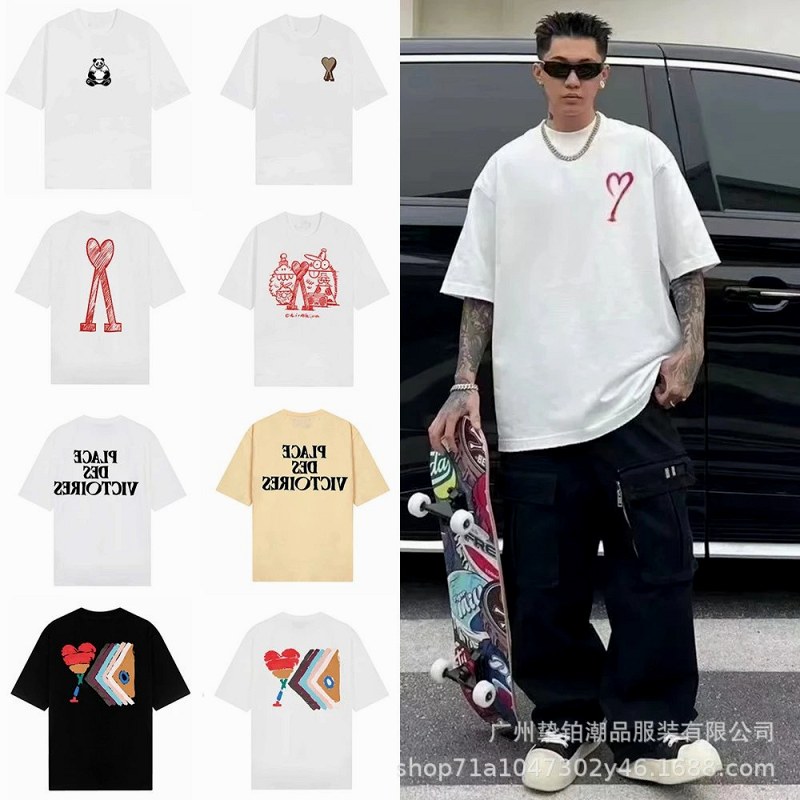
The Ami Paris Everyday T-Shirt Collection lands at $20.60, down from a listed $22.04, on a listing that promises a relaxed, loose silhouette, a classic crew neck, a playful heart motif and a size run stretching from S to 6XL. We bought the navy version, SKU 7702064611, through the same checkout a reader would use, opened it on the Rotterdam bench, and put it through our standard routine: flat measurement on the ruler board, five days of ordinary wear, two washes per the care label, and a second measurement set after each cycle. Two desk members also fit-checked it against the listed size chart.
What the listing actually promises
Strip the marketing language away and the catalog entry is more specific than most. It names a cotton and polyester blend, a pullover construction, a printed heart graphic, a standard thickness suited to warm weather, and a 180 g to 250 g fabric weight band. It also lists six style codes across white, navy, black and beige, all in the same short-sleeve, crew-neck, non-hooded cut. Sizes run S, M, L, XL, XXL, XXXL, 4XL, 5XL and 6XL.
That 180–250 g band is wide enough to cover everything from a light summer jersey to a mid-weight tee, so it tells you less than it appears to. Our sample sat closer to the lower end of that range: thin enough to read the shadow of a hand behind it under the light box, opaque enough on the body in navy.
The fabric label is the real story
Two descriptions sit side by side in the same entry, and they do not agree. One names polyester as the main composition. The other names cotton as the fabric. For a tee at this price that is not a small clerical detail — it decides how the garment behaves in heat, how it drapes, how it takes a print, and how much it shrinks in the drum.
| Listing says | What it would mean in the hand |
|---|---|
| Polyester as main composition | Faster drying, more resistance to creasing, a slightly slicker surface, and a print that bonds rather than sinks into fibre. Less breathable in still, hot air. |
| Cotton as fabric name | Softer against skin, better moisture pick-up, and a real chance of slight shrinkage after the first warm wash — the point our source guides keep flagging. |
| 180–250 g weight band | A range wide enough to cover a light jersey and a substantial one, so it cannot be used to guess the blend either way. |
Our sample behaved like a blend rather than either extreme: it dried overnight on a rail, held its shape at the neckline, and had a faint synthetic smoothness under the fingers rather than the dry hand of a pure cotton jersey. That is consistent with a poly-heavy blend, not proof of one. If verified composition matters to you — and for a garment worn against skin in summer it reasonably might — ask the seller for the care-label photograph before you commit. We are treating the blend as unconfirmed.
Printed heart, not embroidery — and that changes the care routine
The listing says printed, and the sample is printed. AMI's own Ami de Coeur tees are embroidered cotton jersey; this is a graphic laid onto the surface. In use the difference is mostly about edges. A print sits on top of the weave, so it is the first thing to abrade and the first thing to crack. After two cold washes inside out on a gentle cycle, our heart showed no lifting at the perimeter and no visible crazing under the loupe, though the surface texture flattened slightly where the print crosses the ribbing of the chest area.
The care guidance we found for this kind of graphic is consistent: wash inside out, cold, by hand or on a gentle machine cycle, and keep it out of a hot dryer. High heat is described as the enemy of both the print and the cotton content. We followed that and would not expect a print like this to survive repeated tumble drying.
Fit: boxy through the chest, generous at the armhole
This is where the listing is easiest to grade, because AMI publishes its own position. The house describes its T-shirts as deliberately not tight, with the boxy cut being roomier and more relaxed, longer and wider sleeves, relaxed shoulders, and advice to take the smaller size if you are between two. Its unisex guidance is equally clear: men take their usual size, women take one or two sizes down.
Our two fit-checkers found the same pattern the brand language predicts. Through the chest the tee reads relaxed rather than tent-like; through the shoulder it is deliberately wide, with the seam sitting outside the natural shoulder point. The armhole is the detail to watch. A sizing breakdown for Asian builds notes the armhole is cut generously, and we would add our agreement: size up for extra room and you gain it mostly at the opening, which is exactly where you do not want it when you raise your arms.
Practical guidance, then: take your usual size for the intended look, or one down if you want it closer to the body. Nobody on the desk needed to size up.
Five days of wear, two washes, and what moved
- Shrinkage: measured again after each wash and dried flat. The change in body length stayed under our 1 cm reporting threshold on both cycles; the neckline ribbing tightened marginally after the first wash and then settled.
- Colour: the navy held. No visible transfer onto the white towel in the drum, no pale bloom at the seams, no change under the light box.
- Print: no cracking, no edge lift, slight flattening of texture only. Two washes is a short test; this is the number we would want to re-check at nine months.
- Shape: the relaxed shoulder and wide sleeve kept their line; the hem did not curl. No hardware to tarnish on a pullover tee.
- Comfort: fine for a warm five-day stretch, though the blend feel is a touch cool and slick rather than soft, and it does not wick as readily as a pure cotton jersey in still air.
The size run and the J-codes
The S to 6XL span is the strongest practical argument for this listing. Most heart-logo tees stop at XL or XXL; this one carries through 4XL, 5XL and 6XL in the same cut. The colour range is organised by style codes — J101, J103, J109, J118, J120 and J121 — each offered in white plus navy, black or beige. If you are choosing between variants, compare the main image with the specific code's own images, because placement and tone are set per code, not per colour name. What you cannot do is read a flat garment measurement per size: the entry gives none. That makes the first wash the moment of truth for anyone ordering at the top of the range.
Should it go in the basket?
For the money, the cut is the reason to buy. It delivers the boxy, relaxed line AMI describes in its own fit guide, in a colour that behaves, at a price where a printed heart rather than an embroidered one is a fair trade. What it does not deliver is certainty about what you are wearing. Confirm the composition, expect a print that needs cold washing and no hot dryer, and if you are between sizes take the smaller one. That is a manageable set of conditions, not a dealbreaker — and it is why we score this one good rather than excellent.