Two care-label washes, five days of wear and a ruler board later, the $137 Arc'teryx white shell holds its water beading and its seams — but the collar is already greying, and the size run measures roomier than Arc'teryx's own chart.
- Hands-on score
4.0 / 5 4.0 / 5
Editor score 4.0 / 5
- Editor verdict
- A capable white hardshell at agent pricing: water beads, seam tape holds, and two washes caused no colour bleed or meaningful shrink. The cut runs roomy against Arc'teryx's own chart, and keeping Polar White clean is the ongoing cost.
- What works
- Beading returned after a tumble-low dry, with no colour bleed across two washes
- What works
- Seam tape and zip hardware showed no lift or tarnish at 4× loupe
- What works
- Generous cut layers over a fleece without sizing up
- Watch-outs
- Collar and cuffs greyed visibly after five days of city wear
- Watch-outs
- Size M measures closer to Arc'teryx's large on the public chart
- Watch-outs
- Listing gives no flat measurements, membrane details or condition record
Buyers who want a bright technical shell at agent pricing and will wash or spot-clean it regularly rather than treat it as a knockabout jacket.
Anyone who wants a low-maintenance shell that hides dirt, or who needs documented condition and membrane details before paying.
By Priya Raghavan, Reviews Editor
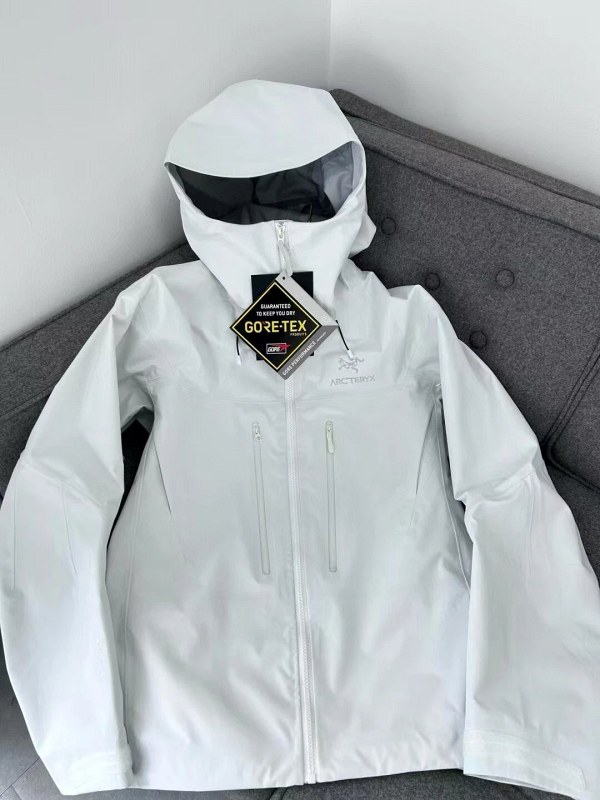
We ordered SKU 7702033467 through the same public agent checkout a reader would use, paid $137.31 of our own funds against a listed $154.90, and opened the parcel at the bench in Rotterdam with the tape measure already out. The listing calls the colourway Polar White and runs S–XXL; the parcel contained one white hard shell with a full-length zip, an attached hood, two vertical chest pockets and a GORE-TEX tag sewn at the front zipper. The dark interior lining shows at the hood opening, as the photos suggested.
The question we set out to answer was not whether a white shell looks good — it does — but what two wash cycles cost you in measurements, beading and brightness. That is the part a listing photograph never shows.
What the listing leaves on the table
The listing text is thin in ways that matter. There is no flat-measurement chart, no fabric or membrane specification beyond the tag itself, and no condition record for the specific piece being shipped. The Chinese-language listing notes in-stock, same-day dispatch. That is a shipping promise, not a product description.
So we built our own baseline: every garment is measured flat on the ruler board before the first wear, two desk members carry out fit checks against the published size chart, and any gap above 1 cm gets photographed. For this jacket the reference chart was Arc'teryx's public men's sizing page, because the listing supplied none.
The bench numbers, before and after
Our sample was a size M. The first measurement set was taken flat, zipped, hood folded.
| Measurement | Before wear | After two washes | Change |
|---|---|---|---|
| Pit-to-pit, flat | 57.0 cm | 56.8 cm | −0.2 cm |
| Back length, collar seam to hem | 71.5 cm | 71.0 cm | −0.5 cm |
| Sleeve, centre back to cuff | 88.0 cm | 87.7 cm | −0.3 cm |
| Hem, flat | 56.0 cm | 55.7 cm | −0.3 cm |
| Weight | 414 g | 412 g | −2 g |
Nothing there is shrinkage you would feel. The half-centimetre in the body sits inside normal tolerance for a laminated shell, and it did not change the layering behaviour.
The fit is the surprise
Pit-to-pit of 57 cm works out to roughly 114 cm around the chest, which on Arc'teryx's public men's chart reads closer to a large than a medium. The jacket does not feel oversized — the shoulders are set and the hem stays put — but it is a roomy medium, and a light fleece or a thin insulated mid-layer went underneath without pulling at the chest or shortening the sleeve.
That puts our sample slightly at odds with the most common owner advice, which is to size up for layering. Our read: try your normal size first if you layer lightly, and only move up if you plan to wear a substantial mid-layer or a helmet under the hood. The collar comes high and the hood has enough volume for a beanie, though we would not call it helmet-compatible on our sample.
Five days, one city, intermittent rain
Five days of normal use on this desk means a bicycle commute, a shoulder bag, two wet afternoons and a lot of coffee. The shell shrugged off drizzle: water sat in beads on the shoulder and sleeve and rolled rather than soaking in. Zips ran smoothly with the jacket on and off in a doorway, and the two vertical chest pockets stayed clear of the bag strap.
"It's a great choice if you're into yellowing, staining, and being unable to be rescued if you're hidden by snow." — an Arc'teryx owner on bright hardshells, r/arcteryx
By day five the cuffs had greyed and the inner collar showed a soft shadow where it meets the neck. Neither was visible at arm's length in daylight; both were obvious under the light box next to the unmarked shoulder panel. This is the honest trade of a white shell, and it is the reason our upkeep sub-score is the lowest on the sheet.
Two washes, by the label
We washed twice according to the care label: 30 °C, gentle cycle, liquid detergent with no softener, then tumble dry on low to reactivate the finish. Before each cycle we ran a white cotton cloth over a sleeve seam and the hem to catch colour bleed; nothing transferred. The printed branding and the tag at the zip stayed sharp, and the zip pulls showed no dulling or tarnish.
Under a 4× loupe, the seam tape showed no lift at the shoulders, hood or hem — the areas where a laminated shell usually starts to fail. Post-wash beading was as good as new, and better than before the first wash, which is the expected result of heat reactivation rather than a sign of anything remarkable.
What we cannot settle at this bench is the membrane itself. A GORE-TEX tag is a label, and beading is a surface finish; neither proves what sits laminated behind the fabric. The listing also says nothing about the piece's condition, so ask for photographs of the care tag, the interior seam tape and the zipper before you commit. Owners of Arc'teryx hardshells have reported delamination after light use, and that is a category-level warning rather than a finding about this jacket.
How the score splits
- Construction and hardware: 4 / 5. Clean seams, no tape lift, zips still smooth after two cycles.
- Weather performance: 4 / 5. Reliable against drizzle and wind; we did not test it in sustained heavy rain.
- Fit and sizing: 4 / 5. Roomy, predictable, but the run reads large against the public chart.
- White upkeep: 3 / 5. Collar and cuffs mark early, and owner threads on light colorways are consistently discouraging.
- Value at $137.31: 4 / 5. A technical shell with working beading and intact tape at a fraction of the label's retail.
If you want a shell that hides dirt and needs no thought, buy it in black. If you want the white one, budget for spot cleaning after wet, grimy days and wash it before the collar sets. That is the whole trade, and the jacket itself held up its end of it.