Our size L measured 56.5 cm across the chest and 71.5 cm long out of the bag, shrinking 1.3 cm after two cold washes. The heat-transfer print, not the cotton, is the part that needs managing.
- Hands-on score
4.0 / 5 4.0 / 5
Editor score 4.0 / 5
- Editor verdict
- A roomy straight-cut cotton tee at a low price, with under 1.5 cm of shrinkage across two cold washes and a heat-transfer print that needs careful handling. Buy it for the blank and the price, not for a graphic that stays crisp.
- What works
- Pure cotton jersey, roughly 231 g in size L, with even neck-rib and hem stitching on our sample.
- What works
- Shrinkage stayed under 1.5 cm after two cold washes, less than buyer reports suggested.
- What works
- Wide S–XXL size run and a very broad colour-code selection at $19.70.
- Watch-outs
- The heat-transfer print showed early micro-cracking and edge lift after two washes.
- Watch-outs
- The cut runs large, so most buyers will want to size down for a regular fit.
- Watch-outs
- Listing publishes no garment measurements, and the 250–300 g figure is ambiguous.
Buyers who want a cheap, roomy cotton crew neck for layering and will wash it cold, inside out, without a dryer.
Anyone who wants a close fit straight from the bag, or a graphic that survives ordinary laundering without special care.
We ordered the Bape graphic print black T-shirt (SKU 7705005398) through the same public checkout flow a reader would use, paid $19.70 against a listed $22.46, and opened the parcel on the Rotterdam bench. It is a straight-cut, crew-neck pullover in pure cotton with a heat-transfer motif on the front, offered in S–XXL and in a colour run so long that the option list alone runs past fifty codes. We bought one and put it through five days of wear and two cold washes, re-measuring after each one.
Bench numbers before the first wear
Every measurement below is flat, on a 1 mm ruler board, with the garment relaxed for twenty minutes first. Sizes were checked against the listing, which does not publish garment measurements at all — so these numbers are the only ones you can work from before ordering.
| Point (size L, flat) | Out of the bag | After wash 1 | After wash 2 | Change |
|---|---|---|---|---|
| Chest, pit to pit | 56.5 cm | 56.0 cm | 55.5 cm | −1.0 cm |
| Body length, high point shoulder | 71.5 cm | 70.8 cm | 70.2 cm | −1.3 cm |
| Shoulder, seam to seam | 48.0 cm | 48.0 cm | 47.8 cm | −0.2 cm |
| Sleeve, from shoulder seam | 22.0 cm | 21.8 cm | 21.5 cm | −0.5 cm |
| Hem width | 55.0 cm | 54.6 cm | 54.2 cm | −0.8 cm |
| Garment weight, 0.1 g scale | 231 g | 228 g | 226 g | −5 g |
Total shrinkage stays under 1.5 cm in every direction, which is roughly 2 percent — a reasonable result for an untreated cotton jersey at this price, and better than the buyer forums led us to expect. Both washes were cold, gentle, inside out, line dried. We deliberately did not tumble dry, because heat is the one variable buyers consistently blame for both shrinking and print damage.
Fit: one size roomier than the label suggests
Two desk members carried out the fit checks. The first, 178 cm and 96 cm chest, normally wears a large and found this one loose through the body with a dropped-feeling shoulder line; the medium sat closer to what he calls a regular fit. The second, 183 cm, was comfortable in the large and would not have sized up. That matches the buyer consensus that these tees run large, with an XL fitting quite big and an L looser than expected — so sizing down is the safe route if you want the tee to sit close to the body rather than hang off it.
The straight cut is genuinely straight: no taper at the waist, no side-seam shaping. Hem width is only 1.5 cm narrower than the chest, which is why it layers well over shorts and denim but looks boxy worn alone.
The print is the fragile component
The motif is a heat-transfer application, not screen print, and the listing itself describes the pattern as random across colour codes. On our sample the transfer sat flat with clean edges when it arrived. Under raking light after the second wash we could see the first faint micro-cracking along one corner of the motif, and a slight lift at the edge of the film. Nothing that shows at arm's length yet, but the direction of travel is clear, and it matches buyer reports that these prints start cracking a few wears and washes in.
Buyers report the print beginning to crack after only a few wears and washes — treat the graphic as the part of the tee with the shortest clock on it.
Practical consequence: wash cold, inside out, mild detergent, no dryer, no iron directly on the motif. That is a narrow care window for a $19.70 T-shirt, and it is the main thing you are agreeing to when you buy it.
Fabric and the moisture-wicking claim
The main fabric is listed as pure cotton in a 250–300 g range with a moisture-wicking function. Our sample weighs 231 g as a whole garment, which is not a like-for-like comparison with a per-square-metre fabric figure — we flag the listing as ambiguous rather than wrong. Hand feel is a smooth, slightly slick single jersey rather than a rough open cotton, consistent with reports that recent Bape blanks feel lighter and cooler than older ones. On a warm afternoon it wore dry and never clung; we would not call it technical fabric, but it does not sit damp against the skin.
Some reviewers of Bape items bought through Chinese marketplaces describe thinner cotton and weaker tag and patch quality. On our single sample the stitching at the neck rib and hems was even, with no loose thread or skipped stitch, and no gap above 1 cm against the listed chart. One sample is not a batch, so treat construction as adequate-but-variable rather than proven.
Labels and what to check on arrival
The printed neck label and wash label are where the value question gets honest. Buyers verify by looking at the ape logo mouth shape, the ® placement and its boxiness on the tag, and the print quality of the wash labels. One buyer also reported a faint odour straight out of the bag; ours was neutral after airing for an hour, but it is worth sniffing before you commit the tee to a drawer. Photograph the label set before the first wash so you have a record if a return becomes necessary.
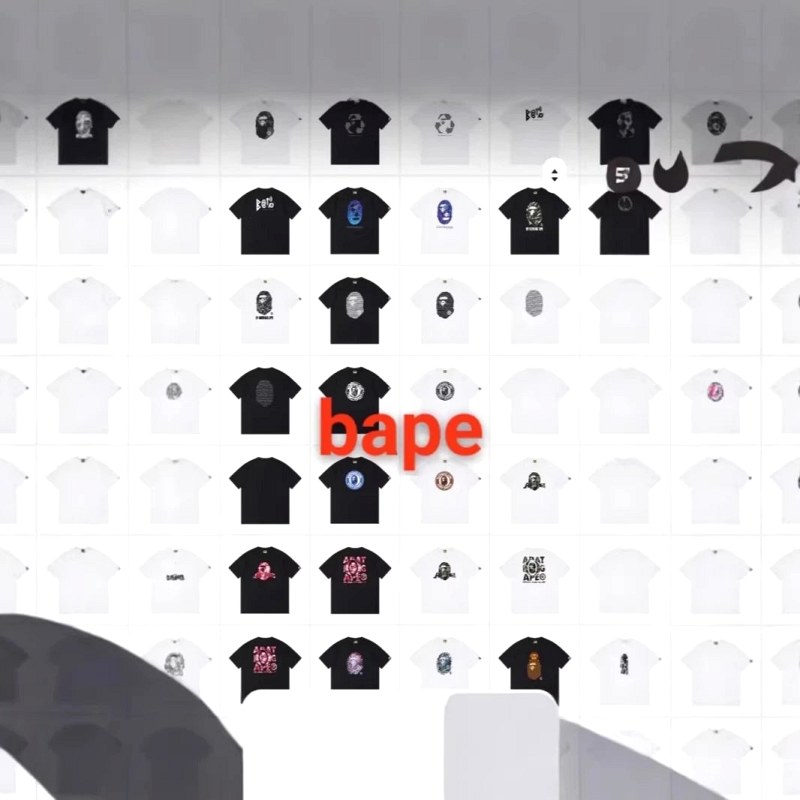
Because the colour list spans dozens of codes across white, black and multi-tone variants, the studio image is not a reliable preview of what your specific code looks like. Ask the agent for an in-hand photo of the exact option, motif included, before shipping — the pattern is listed as random.