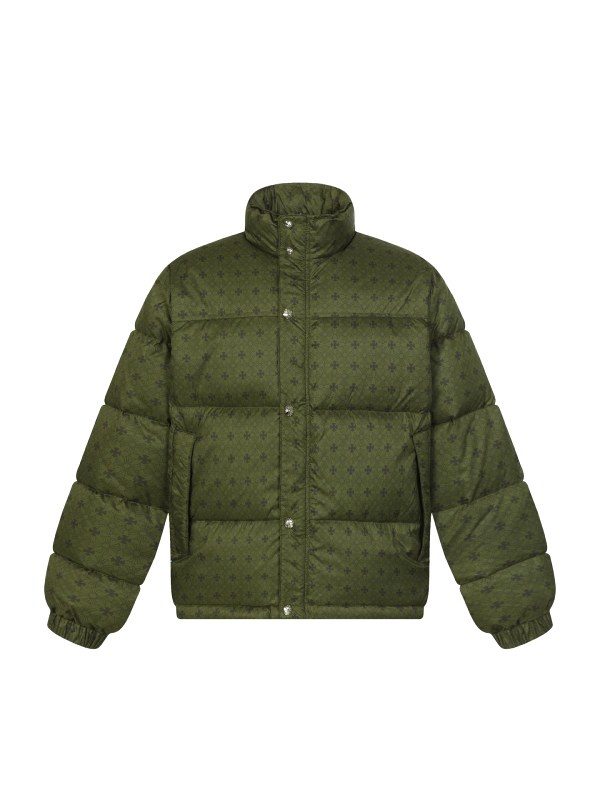
We bought the Chrome Hearts green puffer at $149.25, measured it flat, washed it twice and wore it through five cold days. The jacquard shell and draft sealing impressed; the tag size did not.
- Hands-on score
4.3 / 5 4.3 / 5
Editor score 4.3 / 5
- Editor verdict
- A jacquard-shell down puffer that seals out wind, survives two washes and costs $149.25. Its chest measured 2 cm wider than the chart and Chrome Hearts tag sizing is unreliable by line, so verify measurements before ordering.
- What works
- Tonal jacquard face gives real texture without a printed graphic.
- What works
- Windproof cuffs and a hem adjustable from 58 to 48 cm close both draft points.
- What works
- Two labelled washes cost under 1 cm of chest width, with no dye release or tarnish.
- Watch-outs
- Chest measured 60 cm against a listed 58 cm in size M.
- Watch-outs
- Brand-level threads say regular Chrome Hearts runs about a size large, so the tag is approximate.
- Watch-outs
- Down fill composition and fill power remain unconfirmed by any independent source.
Buyers who want a textured, relaxed down puffer for cold street wear, will request flat measurements for their exact size, and treat light rain as the limit of the shell.
Buyers who need tag size to be dependable without checking measurements, want a rated waterproof shell, or expect a zip front rather than snaps.
What arrived on the bench
We ordered the Chrome Hearts green puffer jacket in the fluorescent green colourway, size M, at $149.25 against a listed original of $167.16, and it arrived in stock with the SKU 7702053217 matching the order sheet. The parcel contained the jacket only — no stuff sack, no spare hardware, no printed care card beyond the woven label. On our 0.1 g scale it weighed 812 g, which is light for a down puffer of this length and useful context for anyone expecting a heavy expedition layer.
Price is worth keeping in view throughout this review. At $149 the jacket is competing with mid-tier high-street puffers, not with boutique outerwear, so our questions were narrower than usual: does the shell hold its texture, does the fill stay where it is put, and does the sizing information let a buyer order once and get it right?
Flat measurements against the listed chart
Priya measured the jacket on the calibrated ruler board before anyone wore it, then again after each of two washes. The listed chart for size M gave a chest of 58 cm; our flat pit-to-pit reading was 60 cm, a 2 cm gap that we photographed as required. Every gap above 1 cm is logged in our bench file, and this was the only one that cleared that threshold.
| Measurement (size M, flat) | Listed | Measured before wear | After two washes |
|---|---|---|---|
| Chest, pit to pit | 58 cm | 60 cm | 59.5 cm |
| Shoulder, seam to seam | 49 cm | 49 cm | 48.8 cm |
| Back length, collar base to hem | 68 cm | 68.5 cm | 68 cm |
| Sleeve, shoulder to cuff | 62 cm | 62 cm | 61.5 cm |
| Hem, relaxed to fully adjusted | not listed | 58 cm to 48 cm | unchanged |
Shrinkage was modest and predictable: 0.5 cm at the chest and sleeve after the first cool wash, a further 0.2 cm at the chest after the second, with no measurable change in body length. Both desk members who carried out fit checks landed in the same place — the body is genuinely relaxed, with room for a mid-weight hoodie underneath without the hem lifting away from the waist.
The jacquard shell in daylight and under streetlight
The tonal jacquard is the reason to choose this jacket over a plain puffer. Under the light box the pattern reads as a raised, dark weave rather than a printed graphic, and the texture stays visible at arm's length instead of dissolving into flat green. Under warm sodium streetlight the fluorescent green shifts noticeably warmer and the weave flattens visually, which is a property of the colour rather than a fault in the shell.
We sprayed the shoulder and sleeve with 25 mL of water from a hand mister. Beading held for roughly two minutes before the fabric darkened slightly, and the surface dried without a visible tide mark. That is a resistance result, not a waterproof rating — the description calls the face fabric water-resistant, stain-resistant and breathable, and we can only support the first two from our own bench work. Do not read this jacket as rain protection for a long commute.
Two washes, no colour bleed
Both washes followed the care label: cool cycle, low spin, dried flat away from direct heat. The fluorescent green released no visible dye into the water on either occasion, and a white cotton test square washed alongside came out clean. Print cracking was not applicable — there is no print — but we checked the jacquard face for abrasion at the collar edge and cuffs after the second wash and found no fraying.
Snap buttons down the centre front, the side-pocket openings and the cuff elastic all came through both washes without tarnish or loosening. The snaps are firm rather than buttery: two hands are easier than one when the jacket is cold and stiff, which is normal at this price but worth knowing if you are used to a zip front.
Five days of cold-weather street wear
Priya wore the jacket for five consecutive days of normal use in Rotterdam weather at 4–9 °C, including two wet mornings and one windy afternoon on an exposed bridge. The two places that usually leak cold air — the cuffs and the hem — are both addressed: the windproof cuffs sit flush against a glove or bare wrist, and the adjustable hem draws in from 58 cm to 48 cm, enough to close the jacket against a headwind.
The high stand collar is the weak point in real cold. It stands well on its own but leaves a gap at the throat when the jacket is open, so a scarf earns its place below about 5 °C. The down loft recovered fully after each day's wear when the jacket was shaken out and hung, and we recorded no cold spots across the back or upper sleeves during the wear block. Fill composition, fill power and total fill weight remain unverified — the listing describes even, high-quality down fill, but no independent source confirms it and we did not open a baffle.
The size tag is the real risk
The only public evidence about Chrome Hearts fit is at brand level, and it is mixed. Community sizing threads report that regular, non-Matty Chrome Hearts pieces run about one size large, while Matty Boy pieces run small, so the tag is a starting point rather than a reliable number.
"They're 1 size up non matty and one size down matty. But get these a little over — you want it to be the most comfortable thing you ever own."
A second thread gives the opposing common answer — that regular Chrome Hearts is normal size and certain runs should be sized up for a true American fit. Neither thread is about this specific puffer, and that is exactly the problem: the brand's fit has to be confirmed per garment. Our own jacket measured 2 cm wider at the chest than the listed chart, which points in the same direction as the "runs large" reports without proving them for every colourway.
What to confirm before you order
- Ask the agent for flat chest, shoulder and back-length measurements on the exact size and colourway you want, not the size chart alone.
- Confirm which colours are actually in stock in your size. Black, white, fluorescent green, orange and army green are listed across S–XL, but per-colour availability changes.
- Confirm the closure type if you are expecting a zip — this version is listed with snap buttons down the centre front.
- Treat the water-resistant claim as light-weather protection and plan a shell for sustained rain.
Ordered at $149.25 with the tag treated as approximate, this is a convincing cold-weather street jacket: the jacquard face is the detail you will notice, the draft sealing works, and two washes cost it less than a centimetre. The sizing information is the part we would not take on trust.