Our size 42 bench pair weighed 336 g, lost 2 mm in the cold wash and stayed gray, but the Bayaband's narrow toe box is the real story. A 4.2 / 5 hands-on result.
- Hands-on score
4.2 / 5 4.2 / 5
Editor score 4.2 / 5
- Editor verdict
- A light, flexible $17.24 clog that survived two cold washes with 2 mm of shrinkage and no colour transfer. The Bayaband last is narrower than the Classic, so fit — not finish — decides this pair.
- What works
- 336 g pair with the flex and spring-back buyers use as a genuine-Croslite check.
- What works
- Two 30 °C washes cost 2 mm of length and left no colour on white cotton.
- What works
- Full size run 35–45 in gray at $17.24 against an $18.81 list price.
- Watch-outs
- Narrower, tighter toe box than the Classic and Baya — the main fit complaint on this model.
- Watch-outs
- Counterfeit Bayaband pairs circulate, so weight, flex and finish need checking on arrival.
- Watch-outs
- General Crocs sizing-down advice points the wrong way for this last.
Buyers who want the Bayaband look in gray, already know they suit a narrower clog, or can try a pair before committing — and who will run weight, flex and finish checks on arrival.
Anyone who needs the roomy toe box of the Classic or Baya, or wants to lock in a size untried; this last runs tight across the forefoot.
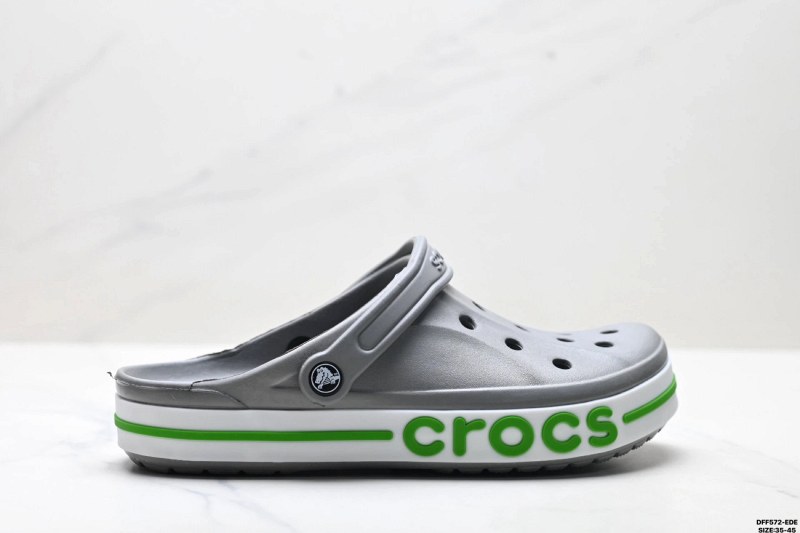
The Crocs Bayaband clog in gray is a backless slip-on with a rounded toe, ventilation holes across the upper and a pivoting strap over the instep. The listing we ordered from carries catalog ID DFF572-EDE and SKU 7705233884, sizes 35 to 45, at $17.24 against a listed original of $18.81. We bought it through the same public checkout a reader would use, opened the parcel on the bench and put the pair through five days of wear, two washes and a full measurement set before scoring it 4.2 / 5.
What arrived, and what the ruler board recorded
The pair reached us in a plain poly mailer inside a second bag, with no retail box, so there is nothing on the packaging to compare against a store pair. The moulded catalog tag inside the strap matched the listing, and the gray upper, white midsole band and green side stripe with the Crocs wordmark all matched the product photography. Moulding seams along the strap anchor were tidy but visible at arm's length, which is normal for a one-piece Croslite build at this price.
We measured the size 42 pair flat on the ruler board before the first wear, then again after each wash:
| Bench measurement | Before wear | After wash two |
|---|---|---|
| Outsole length, heel to toe | 29.3 cm | 29.1 cm |
| Footbed width at the widest point | 9.4 cm | 9.3 cm |
| Toe-box height at the big toe | 4.5 cm | 4.5 cm |
| Strap width | 20 mm | 20 mm |
| Pair weight on the 0.1 g scale | 336 g | 335 g |
The 9.4 cm footbed width is the number worth remembering. It is narrower than the footprint we have logged on Classic clogs in the same marked size, and that single figure explains most of what follows.
The narrow last decides this purchase
Two desk members carried out fit checks against the listed 35–45 chart. Tester A, who has a wide forefoot, reported roughly 0.7 cm of spare width in the size 42 and could feel the sidewall against the little toe after a full day. Tester B, with a standard-width foot, took a 43 and logged a 1.4 cm gap at the instep — over our 1 cm threshold, so it went into the photo log with the tape in frame. Both testers described the same thing in different words: the toe box is shallow and tapered rather than boxy.
That matches what buyers comparing the Bayaband with the Classic and Baya have reported: this model runs narrower and slightly smaller, with a tighter toe box. The general Crocs advice to size down comes from buyers who found their usual Classic size roomy — it points the wrong way here.
If you are between sizes in the Bayaband, take the larger one. We could not make the smaller pair work for a wide forefoot across five days of wear.
Strap, sole band and finish
The strap pivots through two moulded lugs and sat flat against the instep whether we wore it forward or pushed back over the heel. We cycled it 200 times by hand and the lugs showed no whitening or play. The green stripe sits level along the sole and the wordmark stayed centred after both washes, with no lifting at the edges.
Under two light temperatures the gray read as a flat, cool mid-gray without a purple or green cast, and the upper surface was smooth rather than chalky. Buyer verification guides for the Bayaband point to colour vibrancy and a smooth upper finish as the cues to check, so we logged both; on our pair they held up. Confirmation on authenticity from a photograph alone is not possible, which is why the mechanical checks below matter more.
Two washes, no drama
We washed the pair twice at 30 °C on a short cycle in a mesh bag and air-dried them away from a radiator, which is the conservative reading of Crocs care advice. Colour transfer onto white cotton pressed against the upper was nil, the wordmark did not crack, and the strap lugs kept their finish. Shrinkage came to 2 mm in outsole length and 1 mm in width — inside our tolerance but real, and a reason to keep these away from a tumble dryer, since heat is what distorts Croslite.
Ventilation does its job on warm days: the footbed dried within about ten minutes after a wet-foot test, and the holes drained standing water in a few seconds.
The checks we would run on arrival
Counterfeit Bayaband pairs circulate, so we put our pair through the tests buyers use. Weight was 336 g for the pair, in line with the lightweight, flexible Croslite construction genuine pairs show; fakes tend to feel heavier and stiffer. We twisted the pair and folded the toe to the heel without a crease line, and the strap sprang back. If a pair arrives stiff, heavy or dull in colour, those three observations are the ones to raise before wearing it.
Where the $17.24 lands
At this price the Bayaband is a sensible garden, beach and short-errand shoe: light, easy to rinse, and it survived two cold washes with its colour and shape intact. The money question is not build quality, it is the last. Order your normal size or one up, expect a snug forefoot, and treat the size chart as a starting point rather than a guarantee.