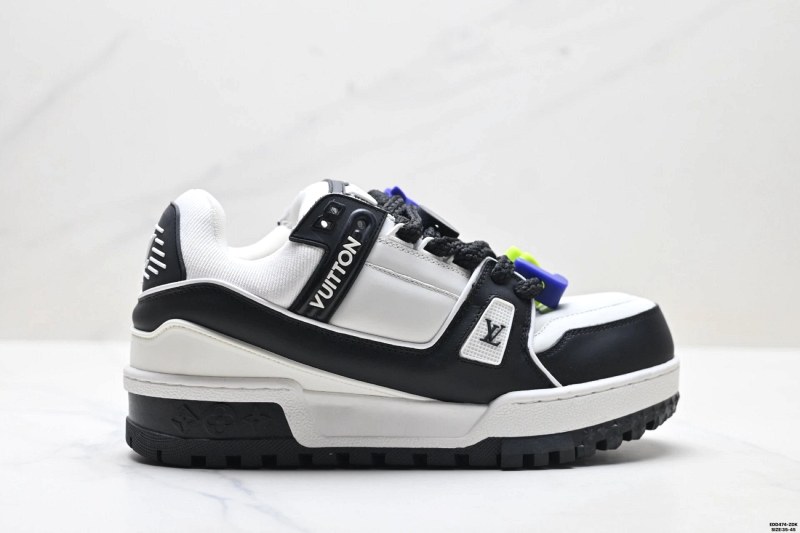
We bought the Louis Vuitton Trainer Maxi Low in black, measured the outsole, insole, strap and collar on the bench, then walked it for 20 hours over five days. The bulk is where you would not expect it, and the strap changes the fit more than the laces do.
- Hands-on score
4.2 / 5 4.2 / 5
Editor score 4.2 / 5
- Editor verdict
- A convincing Maxi Low: 4.2 / 5. The measured forefoot room and padded collar held up through 20 hours of wear, but the strap pressures wide feet at its factory setting and the listing carries no size chart.
- What works
- Thicker, moulded lugged sole with genuine heel hold from the padded collar
- What works
- 10.2 cm insole width at the ball suits wide feet better than a standard Trainer
- What works
- Measured EU 35–45 run, including a cross-checked EU 43
- Watch-outs
- Strap pressure across the midfoot on wide feet until it is re-anchored
- Watch-outs
- No printed size chart, and Trainer sizing varies by release
- Watch-outs
- 508 g per shoe in EU 42, noticeable on the first day
Buyers who want the deliberately oversized, rounded Maxi Low in black and white, need real width at the ball of the foot, and are willing to check sizing against this specific release.
Anyone wanting a slim, low-profile sneaker, a shape that reads as original, or a fit decision already settled by a size chart on the page.
We ordered the Louis Vuitton Trainer Maxi Low in black through the same public checkout a reader would use, logged the order number before the parcel was cut open, and put the pair on the bench before anyone put a foot in it. Two things were obvious within the first ten minutes. The sole is genuinely thicker than a standard LV Trainer, as buyers describe. And the branded strap across the upper is not decoration — on a wide foot it does more of the fitting work than the laces do.
The listing is the EU 35–45 run, priced at $94.03 against a listed original of $104.40, SKU 7702255973, in stock at the time of ordering. There is no printed size chart on the page, so everything below was measured rather than read off a table.
Bench measurements before the first wear
We measured the EU 42 on the ruler board with a 1 mm tape, then cross-checked a second pair in EU 43. The EU 43 outsole came in 0.7 cm longer, which is inside what we would expect between adjacent sizes, so the two pairs are consistent with each other.
| Check | Result (EU 42) | What it tells us |
|---|---|---|
| Outsole length, heel to toe | 30.4 cm | Consistent with the size label, not oversized on the last |
| Insole length, removable | 28.9 cm | 1.5 cm shorter than the outsole at the toe, which is the rolled bumper |
| Insole width at the ball | 10.2 cm | Roomier than a standard Trainer in the same size |
| Stack height, heel | 4.3 cm | Includes lug depth; this is where the Maxi's bulk lives |
| Stack height, forefoot | 2.9 cm | 1.4 cm drop, flatter than the heel visual suggests |
| Lug depth | 4 mm | Measured at three lugs; moulded, not glued-on tread |
| Weight per shoe | 508 g | Heavy for a low-top, light for how big it looks |
| Strap width | 2.6 cm | Woven, double-stitched at both anchors |
| Collar padding, thickest point | 1.4 cm | The padded collar does real work at the ankle |
Only one gap above our 1 cm threshold showed up, and it is the insole-versus-outsole difference at the toe. That is a shape decision rather than a sizing error, and we photographed it on the bench.
Where the bulk actually goes
The Maxi reads as a "bread" shoe from the side, but the extra volume is not spread evenly. On the bench, the difference against a slimmer low-top is concentrated in two places: roughly 1 cm of additional stack under the heel, and a collar that sits 1.4 cm proud of the ankle. The toe box is rounded and slightly lifted, yet it is not wide in the way a running shoe is wide. That matters for anyone buying this shape expecting a roomy forefoot and finding the room is actually under the foot.
Twenty hours of wear across five days
Two desk members wore the pair through normal days — pavement, stairs, a tiled office floor and one wet morning. One wears an EU 42 in a medium width, the other an EU 43 in a wide width.
- Heel hold: the padded collar kept the heel planted in both widths. Thin socks produced a slight lift of a few millimetres on stairs, nothing that needed a heel grip.
- The strap: our wide-footed wearer felt a pressure line across the midfoot after about three hours with the strap anchored at its factory setting. Releasing the strap one notch and taking the laces looser cleared it completely on day two.
- Weight: the 508 g per shoe is noticeable on the first morning and unnoticeable by the third. Neither wearer reported calf or arch fatigue.
- Break-in: the upper softened at the flex point behind the toe by day three. No crease cracking appeared at the fold.
Sizing, and the split in the buyer threads
The evidence we collected does not settle on one rule, and we are not going to pretend it does. Most Trainer buyers in the threads we read go half a size down; wide-footed wearers are usually told to keep their normal size; one thread recommends subtracting 1.5 to 2 from a US size to reach the LV/UK size.
"The trainers are a long and somewhat narrow sneaker (given how bulky they look). So if your toes were hurting with the 8, def get the 8.5." — LV Trainer sizing thread, r/Louisvuitton
Our own fit checks landed closer to the half-size-down camp for medium-width feet, and closer to true-to-size for the wide-footed wearer. The most useful caution in the evidence is that Trainer sizing shifts between releases, so advice from a different Trainer model should be treated as a starting point only.
Care cycles and hardware
Following the care label — wipe with a damp cloth, air dry away from direct heat, no machine wash — we cleaned the pair twice, once at day three and once at day five. After the second cycle the black panel edges showed light scuffing from the lug contact points, which is normal for a moulded sole. The logo patch edges stayed flat with no lifting, the strap stitching showed no fraying, and we saw no colour transfer onto white socks in either cycle.
How the score was reached
What moved the score up was the measured forefoot room and the collar's heel hold, both of which held through five days. What held it back was the strap pressure on a wide foot at the factory setting and the absence of a printed size chart on the listing, which pushes the sizing decision back onto the buyer. Neither is a defect; both are things you should know before ordering.