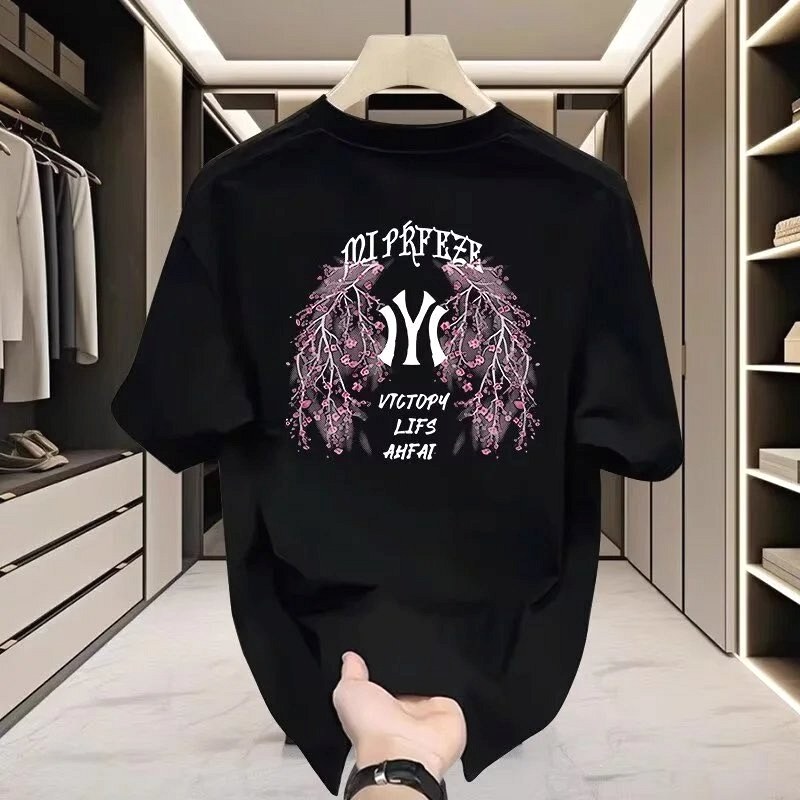
We weighed, measured and washed the black 230 g and white 200 g builds of a $4.48 MLB crew neck. Both matched the listed tolerance, but the brand-level thin-fabric reports sit at odds with the spec.
- Hands-on score
4.0 / 5 4.0 / 5
Editor score 4.0 / 5
- Editor verdict
- Both samples measured and washed cleanly and the 230 g build weighed close to spec, but the listing spans two cotton grades and a wide tolerance band, and the brand's thin-fabric reputation is not fully refuted.
- What works
- S–5XL with a genuinely loose flat cut.
- What works
- 230 g long-staple build weighed close to its listed figure.
- What works
- Two cold washes: no bleed and no print cracking.
- Watch-outs
- The 200 g combed build is thinner and semi-sheer at the chest.
- Watch-outs
- The 1–3 cm tolerance can swing the fit most of a size.
- Watch-outs
- Two washes cannot answer the print-longevity reports.
Buyers who want a relaxed letter-print crew neck across an extended size run and will confirm which cotton build and which flat measurements they are getting before paying.
Buyers who need a confirmed close fit, a heavy opaque hand-feel, or evidence of print durability past several wash cycles before committing.
MLB Special Offer T-Shirts is one of those listings that hides a lot of choice behind a short description. Two cotton builds, several colourways and eight sizes from S to 5XL all sit under the same SKU, and the product copy never says which build you are looking at. So we ordered both: the black 230 g long-staple tee and the white 200 g combed-cotton tee, both in size L, and ran them through the same bench routine we use for every featured garment.
What we checked, and how
Both tees were laid flat on the ruler board and measured at the shoulder seam, the chest (2 cm below the armhole), the body length and the sleeve before either was worn. Each was then worn through five days of ordinary summer use and washed twice on a cold cycle with a colour catcher in the drum, following the care label. We re-measured every marked point after each wash, checked the black tee against a white load for bleed, and inspected the front print under the light box at two colour temperatures.
The two fabric builds, on the scale
| Build | Listed spec | Bench weight (size L) | Hand-feel on arrival |
|---|---|---|---|
| Black long-staple cotton | 230 g | 214 g on a 0.1 g scale | Dense, dry, holds its shape out of the bag |
| White combed cotton | 200 g | 178 g | Lighter, softer drape, faint show-through at the chest |
The scale figures are whole-garment weights, not fabric weight, so they are a consistency check rather than proof of the printed spec. A size L tee uses roughly 0.9 m² of cloth, which puts both samples in the range you would expect from the numbers the listing quotes. The gap between the two builds is real, though: 36 g on the bench, and a visibly different drape on a body.
Flat measurements against the stated 1–3 cm tolerance
On our size L black sample we recorded a 52 cm shoulder, 56 cm chest, 71 cm body length and 22 cm sleeve. Every point landed inside the listing's stated tolerance band, and the arithmetic of the cut is what you would call loose rather than boxy: the chest and shoulder run wide relative to the length, so the shirt drapes instead of hanging square.
The tolerance is the detail worth pausing on. A 1–3 cm allowance on a chest measurement can move you most of the way to the next size, which means two identical-looking orders in the same size can sit differently on the same person. That is not a fault we saw in our two samples; it is a range the listing has written into the product.
Fit on two desk members
We had two people with different builds try both grades against the size chart. The taller tester at 183 cm stayed true to his usual size in the 230 g build and got the intended relaxed fit, with the hem sitting at the hip rather than below it. The shorter tester at 172 cm could have sized down in the 200 g build without losing shoulder room. Nobody needed to size up, but nobody with a preference for a close fit would have been happy in the listed size either.
Two cold washes: shrinkage, bleed and print
After the first cycle the black tee's body length moved by less than half a centimetre and the chest did not move measurably. The second wash produced no further change we could record with a 1 mm tape. Nothing transferred to the colour catcher beyond a faint trace, and the front graphic showed no cracking, lifting or edge flaking under either light temperature. The 200 g white build behaved the same way, though it picked up a slight softness that made the lighter fabric feel closer to the 230 g in hand.
Two washes is a short window, and we want to be plain about the limit of what it shows. The only longevity signal we found in public is a commenter in the MLB community who says the printing on official league tees "starts washing off after 5 or so washes". That complaint concerns licensed Fanatics-made shirts, not this catalog tee, and our two cycles cannot confirm or refute it.
What the brand-level reports get right — and what they miss
"These T-shirts are the thinnest, lightest material I have ever seen, and the printing is especially cheap — the quality is terrible." — translated from the original Chinese in an MLB community thread about league-licensed apparel.
The complaints we found are consistent with each other. Buyers describe MLB-licensed tees as thin and the prints as cheap-looking, and a second thread says the shirts run small and vary between supposedly identical garments. A fan complaint picked up by The Cool Down repeats the same two notes about official shirts in the $60 range: see-through fabric and printing that does not survive repeated washing.
None of that describes the two garments on our bench. Our 230 g sample was not see-through, weighed close to its listed figure and came through two washes cleanly. What the reports describe is a different supply chain at a different price, and treating them as a finding about this listing would be a mistake. They are useful as a prompt, not a verdict.
What to settle before you pay
- Confirm which build the colourway you want actually ships in, because the black and white variants in this album are not the same cloth.
- Ask for the flat chest and body length for your size rather than the label size.
- Compare those numbers to a tee you already own, and add 2 cm if you want the loose look the listing photographs show.
The cut, the fabric grade and the price are all working in the listing's favour. The open question is not the garment we held — it is whether the next order arrives in the same build and the same measurements.