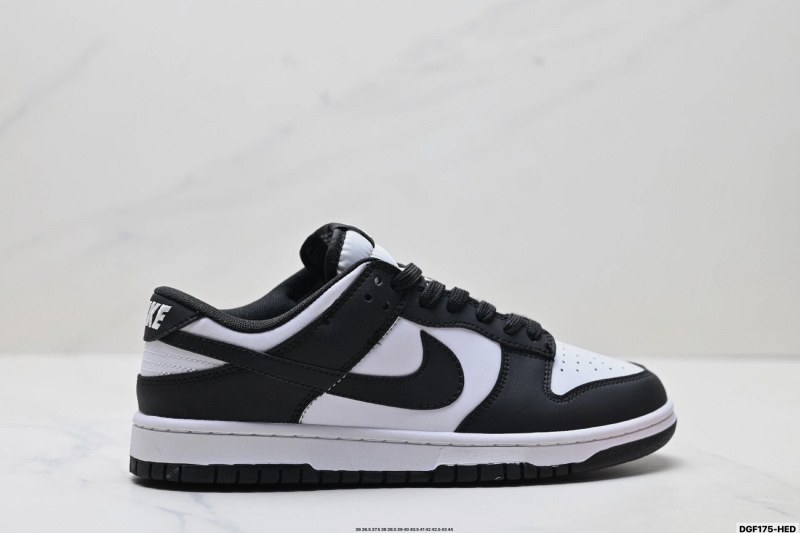
We wore the $15.51 Dunk Low "Panda" for twenty outings across five days, measured two sizes on the ruler board and spot-cleaned twice. Cost per wear is excellent; the size chart and the firm midsole are where the money argument gets complicated.
- Hands-on score
4.0 / 5 4.0 / 5
Editor score 4.0 / 5
- Editor verdict
- A $15.51 Dunk Low that looks right and survives real wear, held back by a firm 1980s-style midsole and a size chart that publishes two conflicting lists with no centimetres.
- What works
- Two pairs arrived with straight panel alignment and correctly placed Swooshes and heel tabs.
- What works
- No colour bleed, cracking or shrinkage after two spot-cleans; internal length unchanged at 27.1 cm.
- What works
- At $15.51, twenty outings works out to under a dollar a wear.
- Watch-outs
- Firm EVA-style foam with no air unit; noticeable underfoot by the third consecutive day.
- Watch-outs
- The 41 and 42 lists disagree and neither gives internal length in centimetres.
- Watch-outs
- Sizing up adds length, not forefoot width — 0.4 cm spare length with no relief across the toes.
Casual wearers in the listed 36–45 range who want the black-and-white Dunk Low look for short days out and accept a firm, flat ride for the price.
Anyone who needs all-day cushioning on hard floors, and wide-footed buyers who want the toe box to actually widen rather than just lengthen.
We ordered two pairs of this listing through the same public checkout a reader would use: an EU 42 for the wear test and an EU 41 for a second fit check at the desk. Both arrived in the standard box with the style code DD1391-100 printed on the label, both were weighed and photographed on the bench before anyone put them on, and both were worn by two different people over five working days — twenty separate outings in total. This review is built around what those twenty outings cost, literally and otherwise.
What the listing says, and what arrived
The product name is the Nike Dunk Black and White "Panda" Classic Series, SKU 7704776778, listed at $15.51 against a struck-through $16.48. The album describes a low-top silhouette with a black Swoosh on white side panels, a white midfoot and toe box with perforations, black laces, a black tongue, a black heel tab with white branding, a white midsole and a black outsole. That is what the parcel contained — colour placement matched the photograph, and the heel tab and tongue branding were both present and correctly positioned on both pairs.
The listed unit weight reads 0.00, which is simply a blank field rather than a real number. On our 0.1 g bench scale the size 42 pair came in at 806 g for the pair, and the sealed parcel at 1.04 kg. Nothing about the delivered weight suggests a hollowed-out build.
The two size lists are the first real problem
This listing publishes sizes twice, and the two lists do not agree. The size line reads 36, 36.5, 37.5, 38, 38.5, 39, 40, 40.5, 41, 42, 42.5, 43, 44, 45. The separate specification line reads 35 / 41 / 36 / 37 / 38 / 39 / 40 / 42 / 43 / 44 / 45 — it adds a 35 at the bottom, drops every half size, and presents the numbers in an order that looks like a stock readout rather than a menu.
Practically, that means a buyer who needs a 36.5 or a 42.5 is working from one list only, and a buyer who needs a 35 is working from the other. Neither list gives centimetres, so there is no stated foot length to check our bench numbers against. We treat that as an unresolved gap rather than something to paper over: the album simply does not tell you the internal length of the shoe in any unit.
Ruler-board numbers
| Size | Internal length | Outsole length | Widest point |
|---|---|---|---|
| EU 41 | 26.6 cm | 27.9 cm | 10.1 cm |
| EU 42 | 27.1 cm | 28.4 cm | 10.3 cm |
Both readings sit within half a centimetre of what we would expect from a general-release Dunk Low, and the half-size step between them is a genuine 0.5 cm rather than a token jump. The internal width is the number to hold onto: 10.1 cm at the widest point is narrow for the length, which matches the fit complaint that comes up most often with this silhouette.
Five days, twenty outings, one firm midsole
Priya wore the 42 for the full test week — desk work, two tram commutes, a supermarket run, a wet school pickup and roughly nine kilometres of pavement across the five days. The first two days felt fine. By the end of day three the sole was noticeable underfoot in a way that a cushioned trainer is not: the foam is firm, there is no air unit in the standard Dunk Low build, and the sensation is closer to standing on a dense rubber mat than to walking on a modern running midsole. It is not painful, and it is not a defect. It is the shape of the shoe.
The second desk member, who takes a wide fitting and normally wears an EU 41, tried both the 41 and the 42. In the 41 her toes touched the front edge of the toe box on the first step and the little-toe side pressed in. The 42 removed the length problem but not the width one. Our documented gap: 0.4 cm of unused length in the 42 with no corresponding relief across the forefoot. If you are wide-footed, this listing's size line will not solve it for you — the half size up buys length, not width.
Creasing arrived on day two, standard for a leather-look upper, in a horizontal band across the toe box. Both pairs creased in the same place, which we read as normal rather than as a panel-alignment fault.
The two spot-cleans
This is a shoe with a spot-clean-only care instruction, so Priya's usual two-wash protocol became two spot-cleans rather than two machine cycles, and we say so plainly instead of inventing a wash test the shoe is not built for. Clean one came on day three with a damp microfibre cloth and a soft brush on the white midsole. Clean two came after day five with the same method plus a mild soap solution on the toe box.
- Colour bleed: none on the white midsole, none onto light socks. The black panels held their edge.
- Shrinkage: re-measured after the second clean — 27.1 cm internal length, unchanged.
- Surface damage: no cracking or peeling; the spots on the midsole lifted with a brush and did not return.
- Hardware and trim: no metal to tarnish; the heel tab and tongue label stayed flat and attached.
Panel by panel on the bench
We checked stitching density around the toe box, the Swoosh attachment, the heel counter and the midsole join. On the 42 we found one loose thread end at the lateral heel, trimmed with scissors and never a structural issue. On the 41 there was a small glue seep where the midsole meets the toe bumper — visible at reading distance, invisible at a metre. Panel alignment was straight on both pairs: the Swooshes sat at matching heights and the heel tabs were centred. Two of two clean-ish pairs is a good result, but it is two pairs, and the wider consensus on general-release Dunk Lows is that quality control varies. We are not going to turn two units into a guarantee.
What twenty outings cost
At $15.51, the arithmetic is the friendliest part of this review. Spread over twenty outings the pair works out to roughly $0.78 per wear, and that falls fast if you keep wearing them. A pair of laces costs more than a week of these. The honest counterweight is the midsole: this is a shoe for a few hours at a time, not for a twelve-hour shift on concrete, and readers who need cushioning are buying the wrong silhouette at any price.
What we would change first
Not the stitching, and not the leather. The size chart. Two conflicting lists with no centimetre figures is the single fixable thing standing between a buyer and the right pair, and it matters more here than on a garment because you cannot take in a toe box. Until the album states internal length, use your measured foot length against our table, allow for a narrow forefoot, and inspect the pair on arrival for glue lines and loose threads. Those are the three habits that make a $15.51 pair behave like a good buy.