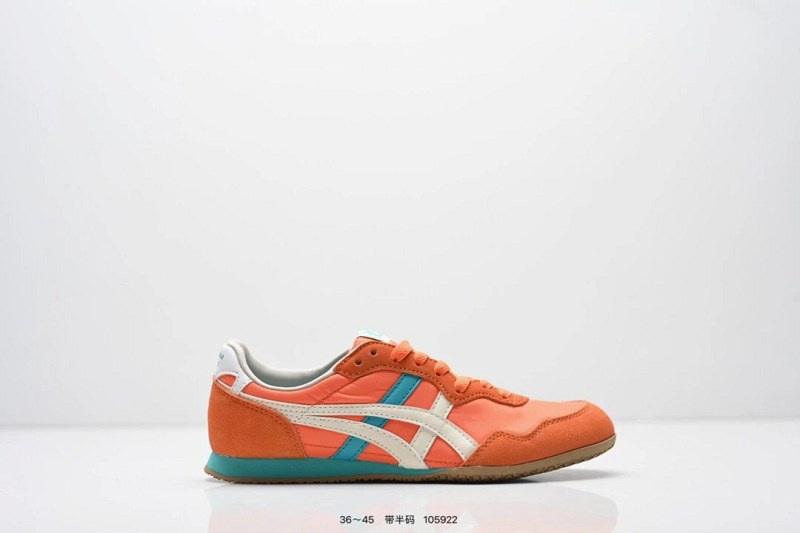
We ordered the $34.48 orange low-top, measured it on the ruler board, wore it for five days and washed it twice. Light and nearly break-in-free — but narrow, thin-soled, and the listing names two different models.
- Hands-on score
4.0 / 5 4.0 / 5
Editor score 4.0 / 5
- Editor verdict
- A light, nearly break-in-free low-top in an easy orange, held back by a narrow last, a thin forefoot and a listing that names two different shoes.
- What works
- Almost no break-in; comfortable from the first full day.
- What works
- Light build and a flexible sole suit warm, dry weather.
- What works
- Orange, teal and gum palette stayed clean through two washes.
- Watch-outs
- Narrow, pointy last with only 11 mm under the forefoot.
- Watch-outs
- Thin outsole is not slip-resistant; the listing itself cautions against rain.
- Watch-outs
- Title says Mexico 66; the box label and feature copy say Serrano.
Dry-weather everyday wearers with average or narrow feet who want a low, light leather sneaker and do not need cushioning under the ball of the foot.
Anyone who needs forefoot cushioning, has a wide forefoot, or walks wet pavement often. The last is narrow and the gum outsole grip is limited.
This is the pair that keeps turning up in agent hauls: an orange low-top with white side stripes, a white heel tab, a thin teal line above a gum outsole, listed at $34.48 against an original $40.90. We ordered a EU 42 through the same public checkout a reader would use, photographed the outer bag and inner wrapping at the Rotterdam bench, and then put the shoes through the desk routine: flat-lay measurement on the ruler board, five days of ordinary wear, and two hand washes to the care label.
The short version is that the shoe does the thing it is famous for — it needs almost no break-in — and does two things badly: it holds the forefoot tight, and it gives you very little under the ball of the foot. There is also a paperwork problem that no amount of bench work can settle, which we come to below.
What the listing claims, and what our bench found
The catalog describes a leather and synthetic upper with a leather lining, a slim slightly upturned toe, a lace-up closure, a layered midsole and a rubber outsole. Most of that held up. The style code on the box is where things get interesting.
| Check | Listing | On our bench |
|---|---|---|
| Size run | 36–45 with half sizes (the spec line also lists 35) | We ordered 42; half sizes were selectable in the variant menu |
| Single-shoe weight | Not stated | 236 g and 248 g — a 12 g pair imbalance |
| Outsole stack, heel / forefoot | "Layered midsole" | 22 mm / 11 mm |
| Internal length, EU 42 | Not stated | 27.4 cm |
| Width at the ball | Not stated | 9.6 cm outside, 9.1 cm inside |
| Upper and lining | Leather + synthetic, leather lining | Matches; the lining is leather at the collar and heel, textile through the mid-foot |
| Outsole | Gum-coloured rubber | Gum rubber with a shallow tread; no deep lugs |
| Box style code | Mexico 66 in the title | 1183B400-407 stamped on the label |
Two numbers matter more than the rest. The 11 mm forefoot stack is the whole story of how this shoe feels over a long day, and the 9.1 cm internal width is why our wider-footed tester could not settle into it.
The naming problem we could not resolve
The product title says Mexico 66. The Chinese-language feature copy on the same listing describes the Serrano, names style 1183B400-407, and talks about a Solyte and EVA midsole. The box we received carries that same style number. We are not going to pretend the bench settles which name belongs on the shoe; what we can say is that the physical object matches the Serrano description more closely than a standard Mexico 66, and that a buyer comparing listings should treat the model name as unconfirmed until they see the box label in a QC set.
If the model name on a listing and the style code in its own feature copy disagree, the style code is the one to check against the QC photographs before you pay.
Fit: two desk members against the size chart
The listing gives EU sizes but no foot-length table, so we ran our own checks. Our first tester normally wears a 42 in most trainers and took a 41.5 here, with roughly a thumbnail of clearance at the toe. Our second tester, a 43 with a wider forefoot, took his usual 43 and reported pressure across the ball after an hour, with the toe box tapering sharply past the mid-foot.
Measured against the size chart's implied allowance for a 42, the internal length left 0.9 cm over a nominal 26.5 cm foot — just inside our 1 cm flag threshold, so no photograph was logged for that. The gap we did photograph was the width: pressed flat, the upper at the ball measures about 4 mm narrower than the midsole beneath it, which is what produces the pinch on wider feet. Both testers describe the last as narrow and pointy rather than roomy.
What that means in practice
- Average or narrow feet: take your usual size, or a half size down if you wear your trainers loose.
- Wide forefoot: size up half a size, and expect a shallow toe box regardless.
- Between sizes: our two testers split, which is consistent with the mixed sizing reports around this model.
Five days of wear
No break-in. That was the surprise. The leather over the toe creases immediately and stays soft, and neither tester had a blister or a hot spot after a first full day. The shoe is light enough — around 240 g a side — that you forget it is on, which is exactly the appeal of this silhouette.
The cost of that lightness shows up on hard pavement. With 11 mm under the forefoot there is almost nothing between your foot and the ground, and by the end of a two-hour walk the ball of the foot is doing the work. Heel strike is fine; the 22 mm heel is enough for a low-top. We would not plan a long city day in these unless you are used to flat, thin-soled shoes.
Grip is the other caution, and it comes from the listing itself: the seller's own copy notes buyer feedback that the outsole is not very slip-resistant and advises against wearing it in the rain. We tested on dry pavement and a damp tiled floor. On the damp tile the gum rubber slid readily; on dry concrete it was fine. Treat this as a dry-weather shoe.
Colour, finish and two washes
The orange is saturated but not neon, closer to a squeezed-tangerine tone than a safety orange, and it reads well against the white stripes and heel tab. The teal accent is a narrow strip sitting just above the gum outsole, visible from the side rather than from above. Panel transitions are clean, with even stitching along the toe cap and the eyestay. Hardware is limited to the eyelets, which showed no tarnish at any point.
We hand-washed in cool water to the care label, air-dried away from direct heat, and repeated the cycle four days later. Colour bleed was the thing we watched for, specifically transfer from the orange upper onto the white stripes and laces. There was none — the white stayed white and the teal edge did not run. Re-measuring after each wash, internal length moved by under 2 mm, which is inside our measurement noise; outsole length was unchanged. No cracking at the toe crease and no separation at the midsole join.
Value at $34.48
At this price the shoe is being sold as a look, not as a performance trainer, and on that basis it delivers: the palette is well judged, the shape is right, the build is tidy and it needs no wearing-in. What you are not buying is cushioning, width or wet-weather grip. If your feet are average or narrow and your days are dry, the trade is a good one. If you need forefoot foam or a roomy toe box, no discount makes this the right shoe.
One last practical note for anyone ordering through an agent: ask for the box label in the QC photographs. It is the fastest way to find out which model and colourway you are actually being sent, and it is the one gap in this listing we could not close from our side of the bench.