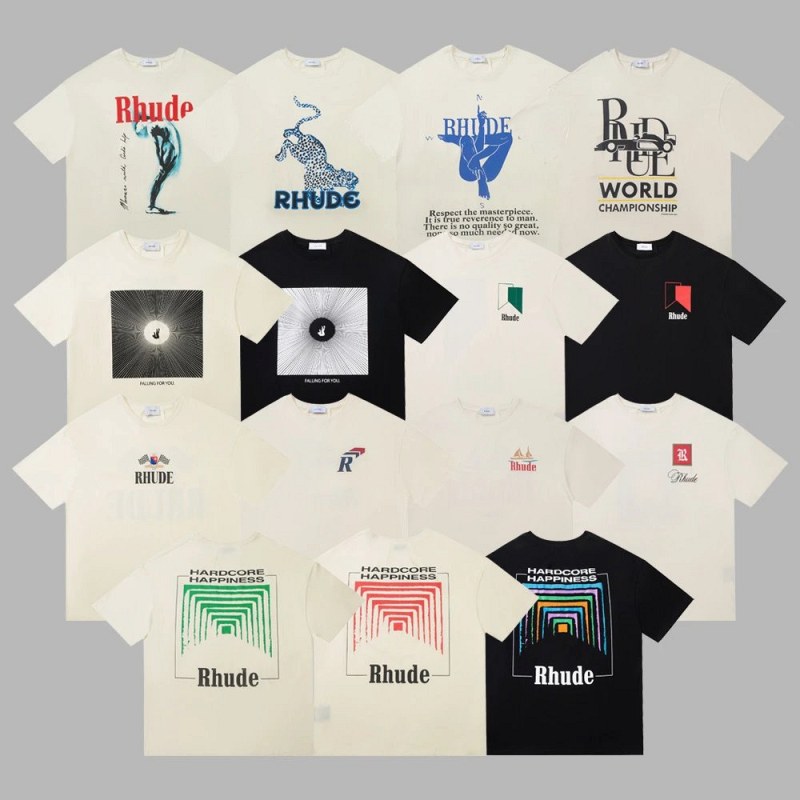
We ordered one Rhude multicolor tee from a 45-code listing at $8.36, measured it flat, and washed it twice. The print held. The hem is another story.
- Hands-on score
4.0 / 5 4.0 / 5
Editor score 4.0 / 5
- Editor verdict
- A genuinely dense combed-cotton tee for $8.36 whose boxy upper block and comparatively close bottom hem pull in opposite directions. The print survived two washes; the sizing does not sort itself out.
- What works
- Combed cotton with a stated 180–250 g weight that feels dense for the price
- What works
- Loose mid-sleeve crew cut with a clean lettering and geometric print
- What works
- Sizes S–XXL across roughly 45 black, white and apricot option codes
- Watch-outs
- Bottom hem sits narrow for a boxy cut, so sizing is not obvious
- Watch-outs
- Buyer reports conflict, from sizing down to medium wearers needing an XL
- Watch-outs
- No per-size measurement table on the listing, plus a 1–3 cm tolerance
Anyone after a relaxed, mid-sleeve summer tee with a graphic print who will compare the listing's shoulder and chest numbers with a shirt they already own before ordering.
Shoppers who want a trim or true-to-size body, who order by the S–XXL label alone, or who dislike a hem that sits close while the chest stays loose.
This listing is not one T-shirt. SKU 7718845670 covers short-sleeve crew-neck pullovers in black, white and apricot bodies across roughly 45 option codes, listed at $8.36 USD against a $9.20 original price. We ordered a single code in size L, measured it on the ruler board, wore it through five days and washed it twice, because a spec sheet cannot tell you how a printed combed-cotton tee behaves after the second rinse.
What the listing promises, and what actually arrived
The page describes combed cotton as the main fabric, a loose streetwear cut, a crew neckline, a regular sleeve type and a stated fabric weight band of 180 g to 250 g. It also lists the sleeve as mid-length in the Chinese specification block while the English description calls it short-sleeve — a contradiction worth knowing about before you order, because the two descriptions describe noticeably different garments.
Two other gaps matter more than the wording. The agent listing carries a shipping weight of 0.00, so there is no parcel-weight figure to budget from, and the page does not publish a per-size measurement table. Our delivered tee arrived in the warehouse QC set matching the option code we selected, with no visible print misalignment on the front graphic.
Bench numbers against the stated tolerance
The listing allows a 1–3 cm measurement tolerance per dimension. Our size L landed inside that band, but not by much on length, and the spread is the whole story of this tee.
| Measure (size L, flat) | Reference number | Our bench | Gap |
|---|---|---|---|
| Shoulder width | 58 cm | 57.5 cm | −0.5 cm |
| Pit to pit | 61 cm | 60.4 cm | −0.6 cm |
| Back length | 74 cm | 73.2 cm | −0.8 cm |
| Sleeve from shoulder seam | Not stated | 21.5 cm | Ends above the elbow |
| Bottom hem, relaxed | Not stated | Narrower than the chest | Unquantified |
The sleeve measurement settles that wording conflict: at 21.5 cm from the shoulder seam, this is a mid-length sleeve that finishes well above the elbow, closer to the Chinese specification than the English description. Nothing here is a traditional short-sleeve tee.
Two washes on a printed combed-cotton tee
We followed the care label — 30 °C, air dry, no tumble — and re-measured after each cycle.
- Shrinkage: back length lost 0.6 cm in the first wash and 0.2 cm in the second, for 0.8 cm total. Pit to pit lost 0.4 cm. Shoulder width did not move measurably.
- Print: no cracking, no flaking and no lifting at the graphic edges. Under 10x magnification one letterform showed a faint ridge where the print meets the weave, but it did not worsen after the second wash.
- Colour: the body read the same against our light-box reference before and after washing. No dye transferred into the rinse water and nothing bled onto the white cotton control cloth we washed alongside it.
- Hardware: there is none. No metal to tarnish, no drawcords, no hardware to test.
The 0.8 cm of total length loss is the number to hold onto. A tee that arrives 3 cm short of the reference is already at the edge of the tolerance, and two washes can push it past the point where the shirt you ordered is the shirt you planned around. The weight band is the other soft figure: 180 g to 250 g is a range, not a specification, so two option codes in this album can legitimately feel different in hand at the same price.
Why the hem decides your size more than the chest
Buyer discussion of Rhude tees consistently describes a boxy, longer body, and Rhude's own published tee chart lists unusually wide shoulders relative to chest — around 58 cm across the shoulders for M and L, against 58 to 61 cm pit to pit. That is a squarer upper block than a standard tee, and our bench numbers agree with it.
Super heavy and great for any season imo. Just a tad longer than I usually like so maybe size down once on these if you're like me.
But the reports are not unanimous. Two owners advise sizing down because the body runs boxy and slightly long; one says a normal medium wearer needed an XL, and notes that smaller sizes felt tight around the bottom hem. We can see where that conflict comes from on our own garment: the chest is generous while the hem is comparatively close, so the two ends of the same shirt argue with each other. If you carry weight at the hip, the hem decides your size. If you do not, the chest does.
How we would choose an option code
- Pick a body colour first, then the print. Black and apricot dominate the code list, with combination graphics such as black-blue, black-yellow, white-green, apricot-green and apricot-red mixed through the middle of the run.
- Measure a tee you already like across the shoulders, pit to pit and down the back, then compare those three numbers to the chart rather than to the S–XXL label.
- If you sit between sizes on the hem, take the larger one and accept the extra room in the chest. Sizing down to fix the hem makes the shoulder line tighter than the cut intends.
At $8.36 the fabric hand is better than the price suggests, and the print work held up under two washes without being babied. The uncertainty is entirely about fit: no measurement table on the page, a stated tolerance wide enough to change the garment, and buyer reports that point in opposite directions. Measure before you pick, and this is a fair summer tee.