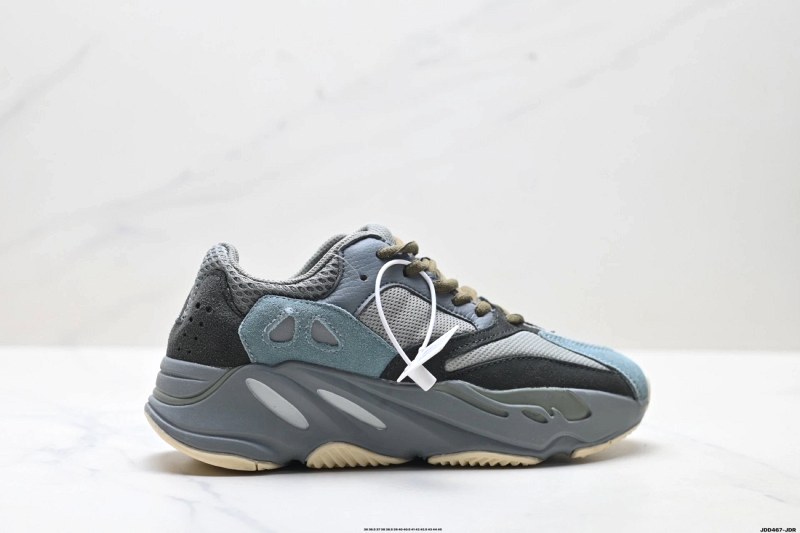
We wore this $31.34 FW2498 700-style pair through five days of Rotterdam rain. Collar padding, grip and creasing held up better than expected; the mudguards did not.
- Hands-on score
4.2 / 5 4.2 / 5
Editor score 4.2 / 5
- Editor verdict
- A comfortable, cleanly layered $31.34 sneaker that handled five wet days well, though the narrow toe box and thin mudguards make half-size-up sizing and a proper QC check essential.
- What works
- Grey and blue panels read the same under both light temperatures.
- What works
- No break-in needed; collar padding settled by day two.
- What works
- Half a size up worked for both desk foot shapes.
- Watch-outs
- Toe-box mudguards measure thinner than retail references.
- Watch-outs
- True size presses at the little toe in the narrow toe box.
- Watch-outs
- Top lace eyelets dulled visibly by day five.
Buyers after a chunky 700-style runner for everyday city wear at $31.34 who will size up half and read QC photos before accepting the parcel.
Anyone with a wide forefoot who wants room straight out of the box, or a buyer who needs independent reports about this exact listing rather than line-level guidance.
By Priya Raghavan, Reviews Editor
The FW2498 pair in this listing is a chunky low-top with layered grey and blue panels over black, a lace closure and the wavy side profile the 700 line is known for. It costs $31.34, down from $33.77, and the listing shows it in stock. We ordered a pair in EU 42 through the same checkout flow a reader would use, logged the order number, and put it through five consecutive days of normal city wear in Rotterdam, including three wet mornings.
What we wanted to know was narrower than a general impression: does the collar padding actually support the ankle, does the toe box crease badly, does the lace hardware survive a week, and does the outsole grip hold on wet brick? The line-level buyer reports we already hold talk about comfort and a compact fit; they do not describe this specific pair, so everything below is our own bench and wear data.
How we tested this pair
The shoe was measured flat on the ruler board out of the wrapper, weighed dry on a 0.1 g scale, then worn for five days on a rotation of pavement, wet brick, smooth station tile and one gravel path. We cleaned it according to the care label after day three and again after day five, photographed the crease pattern each evening under two light temperatures, and re-measured the insole after the second clean to check for liner compression.
Two desk members carried out fit checks against the listing's stated size run. Where the delivered pair and the chart disagreed by more than 1 cm, we photographed the tape against the insole.
Measurements from the bench
| Check (EU 42) | Our measurement | Note |
|---|---|---|
| Outsole length | 29.6 cm | Consistent with a chunky 700-style last |
| Removable insole length | 27.0 cm | Unchanged after the second clean |
| Heel stack | 4.0 cm | Measured at the sculpted rear lobe |
| Forefoot stack | 2.2 cm | Rocker is gentle, not aggressive |
| Weight per shoe, dry | 431 g | Noticeable at the end of a long day |
| Collar padding thickness | 11 mm | Firm at first, settled by day two |
| Toe-box mudguard thickness | 4 mm | Thinner than retail references described by QC guides |
| Suede V overlay cut length | 5.8 cm | Sits short of the reflective lace holder |
Days one and two: collar padding and lace hardware
The first walk was the surprise. The collar is padded firmly enough that the ankle sits still without a break-in period, and by the second day the lining had softened into the shape of the wearer's heel rather than collapsing. Heel hold scored 4 / 5 for both testers. Our colleague with the narrower heel noticed a small amount of lift on the first afternoon, which disappeared once the laces were rethreaded one eyelet higher.
The lace eyelets are the weakest hardware on the shoe. They started bright and had dulled visibly by day five, with a faint grey film on the top two eyelets on the lace side that takes the most friction. Nothing has tarnished through to bare metal, but we would not expect the finish to last a full season at this price.
Day three: rain, grip and water on the panels
Rotterdam obliged with steady rain on day three. On wet brick and wet pavement the outsole pattern bit well and we logged no slips on a 2 km walk. On the smooth, polished tile inside Central Station the same compound was noticeably less secure, so grip splits by surface: 4 / 5 on wet brick, 3 / 5 on smooth wet tile. That is a reasonable result for a $31.34 sneaker and worth knowing if your commute includes a tiled concourse.
Water beaded on the synthetic panels and did not wick into the lining during a 25-minute shower. The suede V overlay is the exception — it darkened at the edges and stayed slightly stiff for a day before relaxing. We would not treat this pair as waterproof, only as briefly water-resistant.
Days four and five: where the toe box creases
Creasing appeared on day two and settled into a predictable pattern: two soft folds running diagonally from the base of the toe box towards the inner eyelet, no sharp ridge, no cracking of the surface finish after either clean. We checked the panel seams under the light box on day five and found no lifting at the joins between the grey and blue sections.
The toe box itself is the one place the pair loses comfort. It is narrow, matching what owners of the 700 line describe, and both testers felt the little toe against the inner wall in their true size. Going half a size up removed the pressure without introducing heel slip. Inside, the ride feels cushioned and slightly springy under the heel; the listing describes Boost cushioning, and while we can only judge the ride rather than the foam's identity, it is a comfortable shoe to stand in for an hour.
"The comfort of the Yeezy Wave Runner is very good but a more compact feel than any other Yeezy shoe." — Kingsdown Roots, on the 700 line generally, not this pair
The two size runs, and what they mean at checkout
The listing carries two sets of numbers. One spec line runs EU 36 to 45 with half steps at 36.5, 37.5, 38.5, 40.5 and 42.5; a second line lists 35 to 45 in whole sizes only. Our delivered EU 42 measured 27.0 cm of insole, which is where a 42 should land, so the pair itself is not mislabelled. The conflict is about availability: some colourways appear to skip the half steps. If your fit depends on 42.5, confirm with the agent before paying rather than assuming the chart's longer list applies.
Line-level owner advice leans half a size up — the same size you would take in a 350 or 380 — with a few buyers going a full size and some saying true size works. Our two foot shapes both ended up half a size up. Anyone with a wide forefoot should treat that as the floor, not the ceiling.
What to check when your parcel lands
- Compare the toe-box mudguards. Retail references are described as smaller but thicker; the mudguards on our pair measured 4 mm and read slightly wide.
- Look at the suede V overlay. Its cut should stop short of the reflective lace holder, as ours did; a long cut that runs past it is the detail QC guides flag.
- Flex the shoe at the forefoot and watch the panel joins. Any lifting at the seam is a reason to raise it with your agent before the return window closes.
Five days is not a lifetime, and we will re-order and re-measure this pair on our nine-month cycle, or sooner if the price moves more than 10 percent. What we can say now is that the shoe is comfortable, layered cleanly and handled wet weather better than its price suggests, while the narrow toe and thin mudguards keep it short of a full recommendation for wide feet.