White Givenchy slides get inconsistent size feedback: some say they run small, some say true to size, and some buyers suggest sizing up. Ordering based on just one person's experience risks mixing up different foot shapes, different sizes, and different measuring methods. A safer approach is to first check the size range of this style, then use your foot length, current slides, and the insole length of this pair to narrow down your choice step by step. 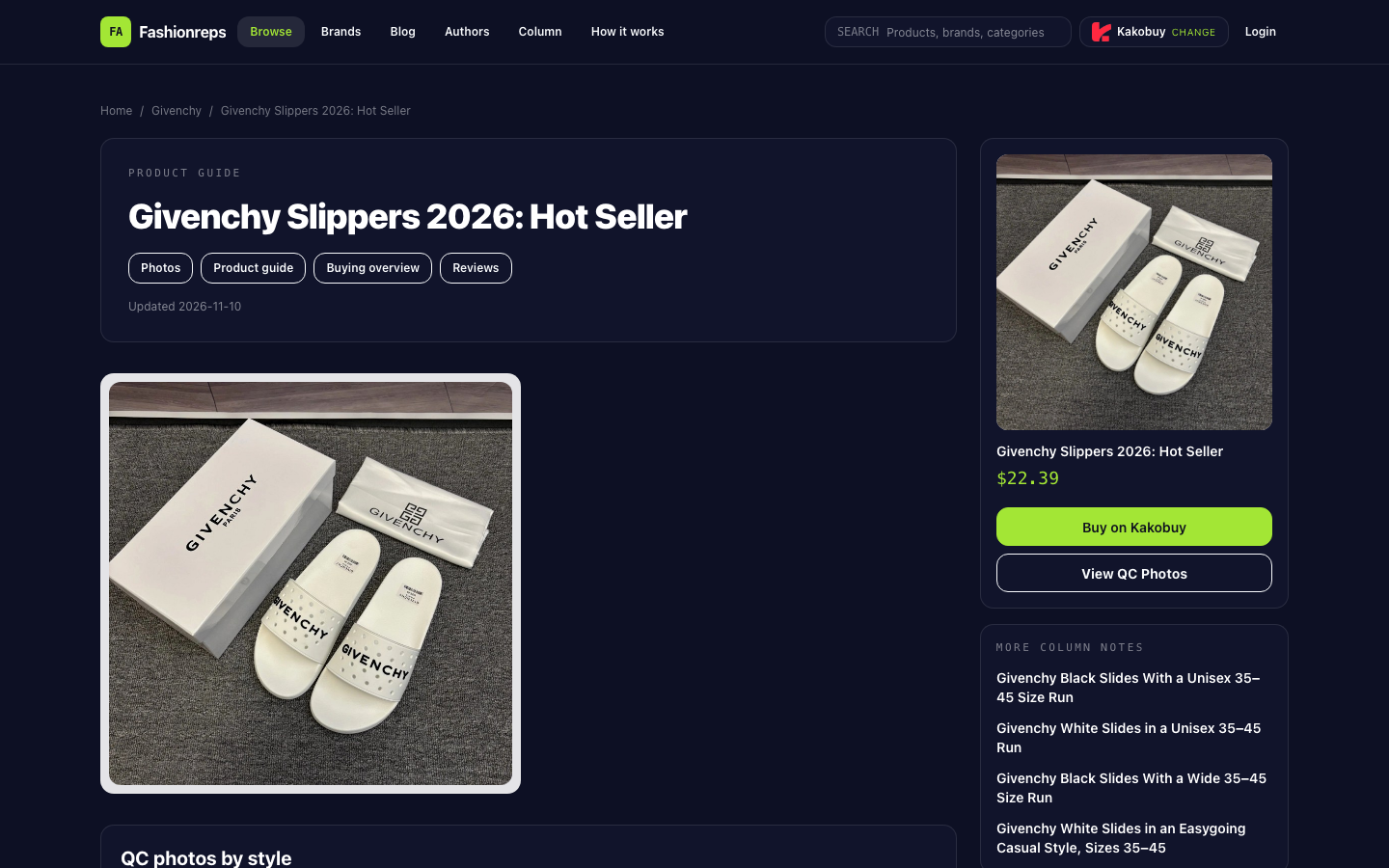
Editor score 4.2 / 5
White Givenchy slides get inconsistent size feedback: some say they run small, some say true to size, and some buyers suggest sizing up. Ordering based on just one person's experience risks mixing up different foot shapes, different sizes, and different measuring methods. A safer approach is to first check the size range of this style, then use your foot length, current slides, and the insole length of this pair to narrow down your choice step by step.

First, identify the style you're dealing with
The product listed on the page is a white minimalist slide with a slip-on, no-lace, no-closure silhouette, available in sizes 35 to 45. This size range is suitable for choosing different sizes of the same style separately, but it doesn't mean two people wearing the same size will get the same amount of room.
The reference price shown on the page is $22.39; the final product price, service fees, and international shipping costs need to be confirmed on the shopping agent platform. Therefore, the price can only serve as a page reference and cannot be used to infer the final landed cost.
Separate the three types of size feedback
The existing information can be divided into three categories, but their applicable scopes are different:
| Feedback | Original information | What it can tell you |
|---|---|---|
| Runs small | A buyer who usually wears 7.5/8 chose size 8 and still felt the slides were a bit small | Certain foot shapes or size combinations may need more length |
| True to size | Another buyer reported that size 39 fit well | At least some buyers find their regular size suitable |
| Suggest sizing up | A rep clothing buyer said they would consider going up a size if buying again | Sizing up may be a personal preference or foot shape need, not a universal conclusion |
These feedbacks cannot be directly combined into "this style definitely runs small" or "you must size up." The page also mentions that a Chinese forum discussion about Givenchy running large actually referred to sneakers, not slides, so it can only serve as brand background, not as size evidence for these slides.
Step 1: Measure your foot length
Prepare a piece of paper, a ruler, and a pen. Wearing the socks you plan to pair with the slides, stand with your foot on the paper, mark the positions along the heel and the longest toe, then measure the distance between the two points. Measure both feet separately, and use the longer one as the main reference.
Don't just record your usual EU or US size. The internal length, upper width, and foot wrapping of different shoe types will affect the feel, and slides are especially prone to the "same size, different feel" situation due to differences in front and back room.
Step 2: Establish a reference with your current slides
Find a pair of slides you often wear that don't pinch your toes or slip off when walking, note their size, and measure the insole length. If the insole is removable, measure directly from heel to toe; if not, estimate along the inner sole, but note that it's an approximation.
Also observe three points: whether there's obvious room in front of your toes, whether your heel easily slips out, and whether the widest part of your foot presses against the edge. Your goal is not to simply copy your existing shoe size, but to find the front-to-back space and width you can accept.
Step 3: Ask the seller for the insole length of your target size
Within the size range shown on the page, first select two candidate sizes, then ask the seller for the corresponding insole lengths. It's best to ask directly about the specific size you plan to buy, and request clarification on the measuring method, because insole length, inner sole length, and outer sole length are not the same data.
If the seller can only provide a measurement for one size, don't automatically extrapolate it to other sizes. The actual increment between full sizes, last width, and upper position can all affect fit. When evidence is insufficient, keeping two candidate sizes is more reliable than forcing a fixed conclusion.
Step 4: Use QC photos for inspection, not as a substitute for size measurement
The page states that seller photos and quality control photos can be used to view the product. After receiving QC photos, focus on whether the left and right shoes are a pair, whether the upper outlines are consistent, whether the sole edges are obviously deformed, and whether the size markings match your order options.
But photos usually cannot accurately tell you the actual insole length, nor can they prove whether the shoes will pinch or slip when worn. Don't use perspective ratios in photos as a substitute for actual measurements. For sizing issues, the seller-provided insole length and your own foot length are more valuable for judgment.
Final selection method
If you have measured your foot length and obtained the insole length of your target size, prioritize choosing a size that is similar to your comfortable slides and leaves reasonable room. Don't automatically go up a size just because you saw "suggest sizing up," and don't ignore your own measurements just because a buyer said true to size.
If you only have foot length without the insole measurement of this style, you can treat the three types of feedback on the page as risk warnings: these slides have no consistent conclusion about running large or small. In this case, you should ask the seller for more information rather than applying the brand size impression from sneakers to slides.
If you can neither obtain the insole length nor confirm the return/exchange policy, you should treat the purchase as a high-uncertainty decision. At least confirm the selected size, product options, QC photo arrangement, and the agent platform's return/exchange rules before ordering; don't treat the reference price or other buyers' wearing experiences as after-sales guarantees.
The core judgment is simple: when you have the insole measurement of this style, rely on foot length and actual data; when you only have whole-size experiences, keep both upsizing and original size possibilities; when you can't get key measurements, don't package conflicting feedback as a definitive answer.