When buying shoes, the easiest thing to misjudge isn't the color—it's whether the page's claim of "true to size" actually provides enough evidence to support your foot shape choice. This article focuses on one specific task: using the fashion-reps product page and subsequent QC photos to determine whether a New Balance 550–style low-top shoe works for wide feet, narrow feet, and whether the size information is suffic
Editor score 4.2 / 5
When buying shoes, the easiest thing to misjudge isn't the color—it's whether the page's claim of "true to size" actually provides enough evidence to support your foot shape choice. This article focuses on one specific task: using the fashion-reps product page and subsequent QC photos to determine whether a New Balance 550–style low-top shoe works for wide feet, narrow feet, and whether the size information is sufficient to place an order.
This article is based on visible fields on the product page, public page disclosures, and the QC photo entry, verified on October 17, 2026. The page shows this is a low-top, lace-up, rubber outsole shoe with sizes 36–44 and eight colorways. The product page reference price is $45.67, but service fees and international shipping must be confirmed separately on your chosen shopping agent platform. This article does not claim any real try-on, receipt, or testing, and does not write uncertain conclusions where page information is insufficient.👟
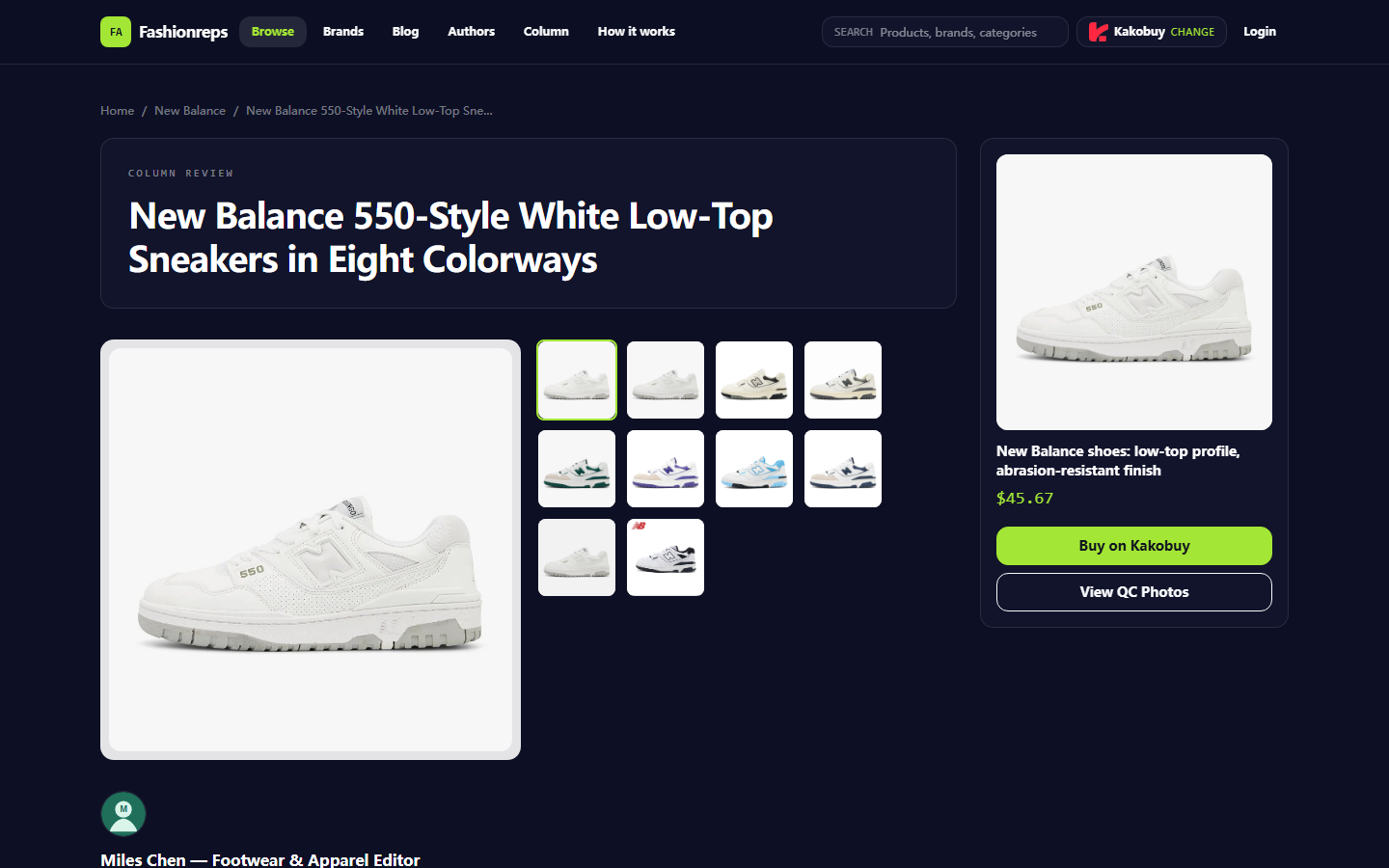
New Balance 550 style white low-top sneaker product page with size and width judgment reference
What This new balance Shoe Fit Task Covers
By the end of this article, you should be able to do three things:
- Determine whether the product page clearly provides size, shoe shape, and width evidence.
- Based on the visible structure of the toe box, upper, and sole, initially rule out foot shapes that are obviously unsuitable.
- Before submitting an order, ask the shopping agent specific size or QC verification questions.
This article is not for people who need medical-grade foot assessment, orthotic judgment, or must confirm exact inner length, forefoot width, and arch support. When the product page does not provide complete centimeter measurements, any conclusion like "fits all wide feet" or "absolutely no rubbing" should not be taken at face value.
Record Shoe Shape, Size, and Width Fields from the Product Page First
Currently visible page information includes: low-top silhouette, lace-up structure, rubber outsole, sizes 36–44, eight colorways, and unisex classification. The page also lists upper, lining, and technical fields as "Other," so you cannot confirm specific leather, fabric, or lining materials from the product page alone.
The page's public fit note is: overall sizing tends to be normal, with a snug fit in the instep or midfoot area, and you should generally start with your usual size rather than deliberately sizing down for a tighter wrap. This note is only a starting point and cannot replace actual measurements of foot length, forefoot width, and existing shoes.
It's recommended to record the following fields before ordering:
- The stated size range and whether half sizes are available.
- Whether width letters are clearly written, such as D, 2E, or other width classifications.
- Toe shape, upper height, and lace coverage.
- Whether the product page provides centimeter data for inner length, insole length, or forefoot width.
- Whether different colorways might use different materials or upper structures.
- Whether reference price, service fee, and international shipping are shown separately.
If the page only shows numeric sizes without width letters or centimeter measurements, you can only conclude "information incomplete," not treat it as evidence of wide-foot friendliness.📏
Visible Judgment for Wide and Narrow Feet: Toe Space and Upper Structure
For this type of low-top lace-up, the midfoot wrap can mainly be observed from three areas: the widest part of the toe box, the lateral expansion space of the upper, and the coverage area between the lace holes.
For narrow or slim feet:
- When the upper sides don't flare out significantly, lacing is usually easier to tighten.
- If the heel contour is clear and the lace coverage area is long, it's theoretically easier to reduce lateral foot movement inside the shoe.
- Still check whether the heel is too loose, as the public page description mentions some wearers reported heel slippage.
For wide feet or wide forefoot:
- The key isn't whether the toe looks round, but whether there's enough lateral space at the widest point.
- If the upper narrows significantly at the forefoot, or the sides nearly close when laced tight, wide feet need caution.
- You cannot infer sufficient width just from "unisex" or "normal sizing."
- If the page doesn't provide a clear width grade, ask the agent to verify insole width or actual in-shoe measurements.
For high insteps:
- A longer lace coverage area usually helps with adjustment, but upper height still can't be inferred directly from size numbers.
- If the page has no upper height info or on-foot photos, you can't guarantee no pressure on the instep.
- Request QC photos of the lace area, side, and top to judge if there's an obvious pinch risk.
What Product Images and Size Charts Can Prove
Main product images are good for confirming appearance, colorway, shoe silhouette, and sole structure, but cannot alone prove comfort, durability, or actual width. A size chart that only lists EU numbers also can't automatically convert to exact inner length, because different lasts and measurement methods may vary.
| Evidence | Can support judgment | Cannot support judgment |
|---|---|---|
| Main product images | Shoe shape, colorway, lace structure, sole appearance | All-day comfort, real feel, wear life |
| Size range | Whether your usual size range is covered | Whether it fits wide feet or high insteps |
| Explicit inner length & forefoot width measurements | Initial comparison with your foot length and width | Guaranteed no rubbing after wear |
| Page fit notes | As a starting size suggestion | Applicable to all foot shapes |
| Post-order QC photos | Appearance, size markings, obvious craftsmanship issues | Material feel, long-term durability |
The public page description says this shoe overall runs true to size but fits snugly in the midfoot; it also mentions the sole feels stiff, with some wearers reporting stiffness in the first few days. "Stiff" and "snug" here are descriptions from the public note, not a comfort prediction for everyone.🙂
What to Check in QC Photos: Upper, Sole, and Size Markings
The product page provides an entry to view QC photos. After getting the photos, it's recommended to check in a fixed order, not just look at color or logo:
- First verify size markings, confirming left/right shoe markings, shoebox label, or inner shoe label match the order size.
- Check if the left and right toe widths are symmetrical, and whether the upper has obvious collapse, creases, or pinching.
- Check lace holes, tongue, and upper seams for obvious misalignment or loose threads.
- Check sole edges, tread pattern, and midsole connection for obvious separation, excess glue, or structural skew.
- Check heel height and heel contour for obvious deformation on one side.
- If you're concerned about width, request actual measurements of insole length, insole widest point, and outer sole width.
QC photos can help spot appearance and size marking issues, but cannot prove comfort after hours of wear, nor that materials are exactly as described. Photo angles, measurement positions, and shooting methods can all affect judgment, so write your questions specifically.
How to Submit Specific Questions to an Agent When Info Is Insufficient
Don't just send "Does this fit wide feet?"—that kind of question can't be verified. A more effective way is to provide your own data and ask the other party to check measurable fields.
You can submit these questions:
- My foot length is X cm and my forefoot widest point is Y cm. Please measure the insole length and widest width for this size.
- Please confirm the order size matches the shoebox, inner label, and left/right markings.
- Please take additional photos of the toe top, forefoot side, and heel front to judge if there's obvious pinching or deformation.
- Please confirm if this colorway has different upper materials or structure compared to others.
- If my instep is high, please take photos of the upper with laces fully relaxed.
- If size markings are wrong, there's obvious separation, or severe asymmetry, please pause shipment and explain available options.
These questions correspond to size, width, instep space, colorway differences, and QC risk, making it easier for the agent to reply item by item. Do not send passports, payment cards, full shipping labels, or other unnecessary personal information.🔒
Comfort and Durability Conclusions You Should Not Infer from the Page
The product page and public description provide limited reference, but the following conclusions cannot be directly inferred:
- You cannot conclude wide feet don't need size adjustment just because it's marked true to size.
- You cannot conclude the sole is durable just because it has a rubber outsole.
- You cannot conclude it won't crack or wear after prolonged friction just because the page mentions wear resistance.
- You cannot conclude all eight colorways use exactly the same materials just because one looks the same.
- You cannot conclude it's suitable for all-day standing or long walking just because someone said it was okay for a few hours.
- You cannot conclude it won't rub or press the instep just because the upper looks flat in photos.
The page description overall describes the fit as snug in the midfoot with a stiff sole, and there are public reports of heel slippage and initial stiffness. For people who need all-day standing, long-distance walking, wide forefeet, or high insteps, these are risks requiring further verification, not minor details to ignore.
Foot Shape and Evidence Checklist Before Buying
Before ordering, you can decide in this order:
- First measure your foot length and forefoot widest point, ideally in the afternoon or evening, standing with both feet on the ground.
- Compare with the product page size range to confirm your usual size is within 36–44.
- Check if the page provides width or centimeter measurements; if not, keep "uncertain" as a purchase condition.
- If your feet are narrow, focus on checking heel looseness and whether laces can be tightened effectively.
- If your feet are wide, focus on requesting forefoot width and insole width measurements; don't size down on your own.
- If your instep is high, request additional photos of the lace area and upper side.
- After ordering, check QC photos for size labels, left/right symmetry, toe shape, sole edges, and obvious glue marks.
- Only decide on consolidation and shipping after key questions are answered; service fees, international shipping, taxes, and route restrictions should be based on your chosen shopping agent's checkout page.
This shoe is more suitable for people who know their usual size, can accept a snug midfoot and stiff feel, and are willing to recheck details at the QC stage. If you need clear width, ample forefoot space, all-day standing comfort, or must confirm exact inner length and material source, and neither the product page nor QC can provide that evidence, it's not recommended to order based solely on "true to size."
Article Image
