Bottom Line: Don't Just Apply the 'Size Down Half to Full Size' Rule For wide feet or buyers between sizes, Rick Owens colored high-tops are better suited to a process of "foot measurement—seller physical measurement—toe room check" rather than directly applying brand-level buyer feedback. Existing sources include both sizing down half to a full size, true to size, and sizing up for wide feet, and none of that feedback has been confirmed as specifi
Editor score 4.2 / 5
Bottom Line: Don't Just Apply the 'Size Down Half to Full Size' Rule
For wide feet or buyers between sizes, Rick Owens colored high-tops are better suited to a process of "foot measurement—seller physical measurement—toe room check" rather than directly applying brand-level buyer feedback. Existing sources include both sizing down half to a full size, true to size, and sizing up for wide feet, and none of that feedback has been confirmed as specific to this particular colored high-top style.
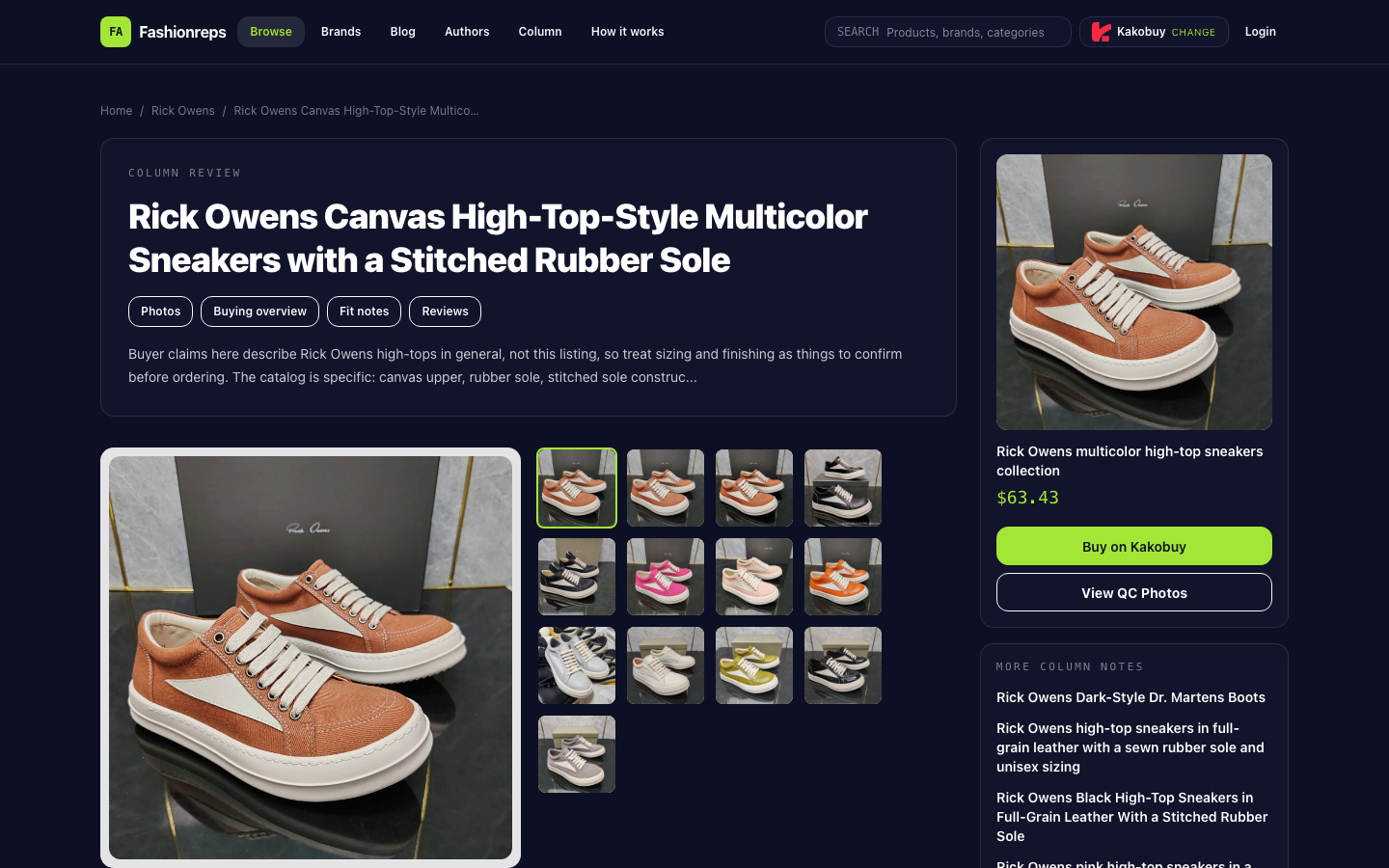
Page information shows this series features canvas uppers, rubber outsoles, stitched sole construction, round toes, and lace-up design, with listed size ranges of women's 36–43 and men's 38–47. That range only means a wide selection of sizes is available, not that a given size's forefoot width or insole length will fit your foot shape.

Step 1: Record Your Own Verifiable Data First
Before asking the seller, lock down your foot data. It's best to measure when your feet are slightly swollen from a full day of activity, wearing the socks you'd typically pair with high-tops.
- Place a piece of paper on a hard floor and stand with your heel against a wall.
- Trace each foot separately and measure from the back of the heel to the longest toe.
- Measure width at the widest part of the forefoot; don't just record foot length.
- Use the longer foot as your primary sizing reference, but keep both feet's data.
- Note your current comfortable high-top brand, size, insole length, and forefoot feel for comparison.
If you can only provide one number, prioritize the longer foot's length; but for wide feet, forefoot width is equally critical. Giving the seller only foot length makes it easy for them to ignore horizontal toe room.
Step 2: Ask the Seller for Physical Measurements of Your Target Size
Don't just ask "does this run large?" or "will wide feet fit?" Those questions usually get vague advice. A more useful approach is to first narrow down to one or two candidate sizes, then ask the seller to measure the actual shoes.
Request the following:
- Insole length for the target size, ideally specifying measurement start and end points.
- Outsole length, as supplementary info, not the sole basis for foot space.
- Width at the widest part of the insole or shoe interior forefoot.
- Whether the toe box has obvious narrowing, reinforcement, or non-compressible structures internally.
- Whether the tongue, laces, and collar can be adjusted to relieve forefoot pressure.
- Any differences between left and right shoe measurements for the same size.
It's best to have the seller provide photos with a ruler and confirm the photos correspond to the color and size you intend to buy. Page info indicates multiple color options but provides no measured interior data per color and size, so you cannot substitute the page's size range for physical measurements.
Step 3: Judge by Clearance, Not Just the Size Label
Once you have the measurements, compare insole length to your longer foot length, then factor in forefoot width. Insole length doesn't equal usable internal length because the insole may not lie completely flat, and the round toe shape changes the actual front space.
For those whose foot length is near the boundary between two sizes, list both candidate sizes and compare three things:
- Whether length clearance is sufficient and the longest toe won't hit the toe cap.
- Whether the widest part of the forefoot will be constantly squeezed by the upper.
- Whether pressure remains concentrated near the metatarsophalangeal joint even after loosening the laces.
If going up a size only adds front length without improving forefoot width, blindly sizing up can cause heel slip and unstable walking. Conversely, if the smaller size's length is already close to your foot length, you shouldn't force it just because "high-tops will stretch" even if the upper can be relaxed via laces.
Decision Order for Three Types of Buyers
Narrow-foot buyers can first check foot length against insole length, then confirm heel stability after tightening laces. The brand-level advice to size down half to a full size may be useful for narrow or low-volume feet, but still can't be taken as a definitive answer for this shoe.
Regular-width buyers should compare true-to-size and sizing-down advice side by side, focusing on the seller's provided insole length and interior width. If both sizes meet length requirements, prioritize comparing heel hold, lace adjustment range, and return/exchange conditions.
Wide-foot buyers should look at forefoot physical width first, then decide whether to size up in length. The wide-foot sizing-up advice in the sources is only brand-related buyer feedback, not verified as physical results for this specific listing. Therefore, only after the seller provides the target size's interior width, insole length, and clear measurement photos is it appropriate to proceed.
Before Ordering, Confirm Returns and Inspection Window
This page's reference price is $63.43, but the page also states that final item price, service fees, and international shipping must be confirmed on the shopping agent site. Price cannot be used to infer sizing or stock, nor replace checking return/exchange terms.
Before ordering, confirm:
- Whether the agent platform or seller accepts returns/exchanges for size issues.
- The timing for return/exchange requests: after ordering, after warehousing, or before shipping.
- Whether you can request additional measurements or photos at the warehouse stage.
- Who bears the cost of returning to the seller and reshipping if the size is wrong.
- Whether there is enough time after the item arrives at the warehouse to view photos of the insole, outsole, and upper before deciding to ship.
Source materials also mention reports of glue marks and workmanship consistency differences in Rick Owens high-top related buyer feedback. This article does not treat those reports as a conclusion for every pair in this model; for wide-foot buyers, their practical relevance is this: if sizing is already uncertain, you should check toe shape, upper stress points, and left-right differences at the warehouse stage rather than just looking at the box size.
Final Judgment Criteria
If you have wide feet or are between sizes, at least obtain these three pieces of information before deciding: longer foot length, candidate size insole length, and candidate size forefoot width. If the seller can only answer "normal size" or "recommend going down a size" without providing physical measurements, the current evidence is insufficient to determine sizing.
A situation you can continue verifying is one where the seller can provide measurement photos of the corresponding color and size, and the interior length and width both explain your foot data. A situation to postpone purchase is one where you can only rely on brand-level conflicting feedback, cannot confirm return/exchange terms, or cannot view physical item information before shipping. The conclusion here is not that "a certain size fits all wide feet," but whether this particular purchase has sufficient evidence to proceed.